








As a senior HR leader, you’ve heard the agile rallying cries of “move faster,” “be flexible,” and “put the customer (or employee) first.”
Now it’s time to put those principles into practice on your own turf.
Sprint to Success is all about the how: a practical blueprint for embedding agile ways of working – like sprints, daily stand-ups, and retrospectives – into HR teams.
We’ll explore how to run HR sprints and ceremonies, where to pilot agile in HR (and why), how to build and prioritize an HR backlog by employee impact, and how to iterate solutions based on what you learn each sprint.
By the end, you should have a clear game plan for turning agile from buzzword to everyday behavior in your HR organization, setting the stage for faster, more human-centered service.
Chapters
- From Principles to Practice: The Agile HR Blueprint
- Starting Small: Pilot Projects for Agile HR
- Building the HR Backlog: Prioritize by Employee Impact
- Running the HR Sprint Cycle: Ceremonies and Cadence
- Agile in Action Across the HR Lifecycle
- Iteration and Improvement: Learning as You Sprint
- Conclusion: Agile Today, Agile Tomorrow
.png?width=94&height=94&name=Copy%20of%20LinkedIn%20Ads%20TOFU%20Lead%20Gen%20-%20AI%20playbook%20-%20Square%20(5).png) Cultivating an Employee-First Mindset
Cultivating an Employee-First Mindset
Learn how to transform HR into a people-first function that builds trust, designs better experiences, and drives real business results in this interactive, 10-minute guide. Read Now.
From Principles to Practice: The Agile HR Blueprint
Agile in HR, in a Nutshell
In a previous chapter, we established why agile matters for HR – speed, flexibility, continuous improvement, and a relentless focus on delivering value to employees (our “customers”). But knowing the principles is one thing; implementing them is another.
Agile is fundamentally an iterative, customer-centric approach to work that replaces big, rigid projects with smaller, incremental improvements delivered in short cycles (AIHR).
In HR’s context, this means breaking down mammoth initiatives (like revamping performance management or rolling out a new HRIS) into bite-sized pieces, delivered via rapid sprints with frequent check-ins and feedback loops.
Instead of the traditional HR tendency to spend months designing the “perfect” program before launching, an agile HR team pilots a minimum viable solution in weeks, gathers input, and iterates – continuously refining policies, processes, or tools based on real-world feedback.
Why Now?
Simply put, the world HR serves is moving faster than our old processes can handle. Employee expectations change quickly, business needs pivot, and agentic AI is demanding rapid HR response.
Agile offers a way to meet these challenges head-on. When done right, agile HR can dramatically accelerate delivery of new solutions and boost their impact. For example, in one case a new regional talent program was rolled out 75% faster than before thanks to agile methods (McKinsey).
In another, switching to an agile HR model drove a 20% increase in employee engagement scores and a 25% gain in HR team productivity (McKinsey). Faster cycles, happier employees, and more productive HR: these are outcomes senior leaders can get behind.
The Blueprint Ahead...
We’ll cover how to structure an HR agile team, define roles (yes, even HR needs a “Product Owner” type role and maybe a Scrum Master), and maintain an HR backlog of work to be done.
We’ll walk through a typical sprint cycle in HR, from planning to daily stand-ups to sprint reviews and retrospectives, translating these agile ceremonies into the HR context.
And critically, we’ll discuss where to begin (often with a small pilot project in an area ripe for improvement) and how to prioritize what to tackle first based on employee impact and effort.
Throughout, the focus remains on being experience-first and jargon-free: agile is a means to an end, and that end is better employee experience and business outcomes. Agile can transform HR, but to succeed we must blend the boldness to try new ways with the pragmatism to learn and adapt as we go.
Starting Small: Pilot Projects for Agile HR
One of the smartest ways to introduce agile into HR is by starting with a pilot. Rather than flipping a switch and declaring the entire HR department “Agile” overnight (a recipe for confusion and resistance), you begin with a focused experiment.
This could be one HR team or project that becomes the proving ground for agile practices.
Why a pilot? Because it lets you work through kinks, demonstrate quick wins, and build buy-in on a manageable scale before scaling up.
In fact, many organizations initially pilot agility in one team to work out the wrinkles and showcase success – although HR’s breadth can make a single-team pilot tricky, it’s still feasible with the right scope.
Choosing the Right Pilot
Pick an area of HR with a clear pain point and a strong link to employee experience. Think of domains where traditional HR cycles are painfully slow or where employees frequently voice frustration.
Onboarding is a classic candidate – if it currently takes 10 days and five forms for new hires to get set up, that’s a ripe target for an agile makeover (as one example, a company sought to cut onboarding from 10 days to 3 by sprinting on process improvements (AIHR)).
HR service delivery (HRSD) is another prime area for agile pilots. This includes your employee helpdesk, knowledge base, and case management processes – basically how HR serves employees day-to-day. Improvements here have immediate, visible impact (employees feel the difference in response times and ease of getting help), and the work can be segmented into many small enhancements, perfect for iterative development.
For instance, you might pilot an agile approach in the HR help center team to reduce case resolution time or update knowledge articles continuously. Because HRSD touches large portions of your workforce, positive changes there can quickly boost employee satisfaction and even lighten HR’s load by deflecting repeat inquiries. It’s a high-impact sandbox to prove out agile.
Other good pilot project ideas include: a sprint to redesign a cumbersome policy or HR process (e.g. parental leave application, performance review process), a talent acquisition initiative (e.g. speeding up hiring for a specific role group), or implementing a new HR tech tool in an agile way. The key is to frame the pilot around a meaningful problem; something where faster, more iterative work will clearly outperform the status quo.
One real-world example: Asahi Europe’s HR team ran two quick sprints to tackle specific challenges: a “Graduate Hiring Sprint” to revamp their recruitment approach, and a “Performance Rating Sprint” to simplify an outdated evaluation system (Agile Alliance).
Each sprint lasted just a few days to a couple weeks, but delivered concrete outcomes (e.g. a redesigned hiring framework) and validated the agile approach on a small scale. Those early wins helped convince skeptics and paved the way for broader adoption later.
Secure Buy-In and Set Expectations
Even for a pilot, it’s crucial to get leadership support and align stakeholders on what you’re doing. Explain to your CHRO and team leads that this is a controlled experiment to make HR more responsive and not some radical free-for-all.
Define success criteria up front (e.g. reduce time-to-hire by X%, or improve new hire onboarding satisfaction scores) so everyone knows what to look for. And be transparent with the HR team about why you’re trying agile. Some colleagues may be wary, thinking “Agile is an IT thing” or “does this mean no planning?”
Combat these misconceptions with clear communication: agile isn’t chaos, it’s just a different way to plan and execute; one that still involves discipline and strategy, just in shorter cycles. By positioning the pilot as a learning opportunity, not a permanent mandate, you give the team psychological safety to try new practices, stumble, and improve. That learning mindset is critical, because an agile transformation is a journey of continuous improvement.
Lastly, set a time box for the pilot itself. For example, decide that for the next 2-3 months, the HR Ops team will operate in agile mode (with sprints, stand-ups, etc.) focusing on a defined backlog of service improvements. At the end of that period, you’ll evaluate what worked and what didn’t.
This time-bounded approach makes the change feel finite and manageable. Of course, the hope is the pilot’s success means you won’t go back to old ways, but framing it this way lowers the perceived risk for everyone involved. It’s much easier to say “Let’s try this for a quarter” than “This is our life now, forever.”
Building the HR Backlog: Prioritize by Employee Impact
At the heart of any agile operation is a backlog – a prioritized list of all the tasks, improvements, and ideas waiting to be worked on. In HR, think of your backlog as the running to-do list of enhancements to HR services, programs, and processes.
This might include user stories like “Enable electronic signatures for onboarding forms,” “Update parental leave policy language for clarity,” “Launch a pilot mentorship program,” or “Implement chatbot for Tier-1 HR FAQs.”
The backlog captures everything the team might tackle, but unlike a traditional long-term HR project plan, it’s continually reordered and refined based on changing needs and feedback.
Employee-Centric Prioritization
The golden rule for your HR backlog is to prioritize based on value and impact, not just urgency from HR’s point of view. In agile HR, VALUE is often synonymous with employee impact: how much a given item will improve the employee’s experience or solve an employee problem.
For instance, an item that could significantly reduce employees’ wait time for answers (high impact) should likely rank above one that just tweaks an internal HR workflow with minimal noticeable effect on employees.
Agile HR teams consciously shift their focus from internal process for its own sake to what delivers value to our “customers,” i.e. employees (Indeed). A useful mental test is to ask: if we complete this backlog item, will an employee actually feel a positive difference? If the answer is barely or not at all, question why it’s on the backlog.
Of course, impact isn’t the only factor – effort and feasibility matter too. This is where a simple prioritization framework can help:
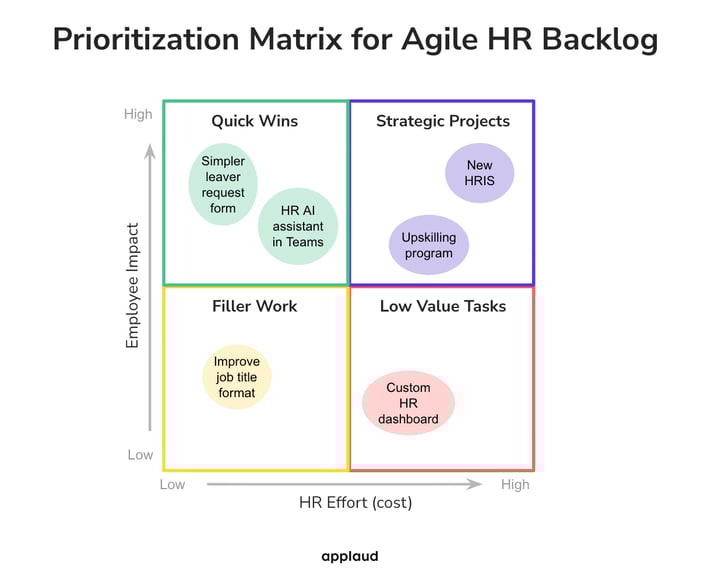
The sweet spot to target first is high-impact, low-effort tasks – the classic “quick wins.”
These might be small changes that nonetheless remove friction for many employees. For example, adding a dedicated HR AI Assistant in Microsoft Teams or Copilot might be a minor tweak technically (low effort) but could dramatically cut down employees’ time spent hunting for HR information (high impact).
Items that are high impact but high effort (the “strategic projects”) come next – you’ll do them, but you might break them into smaller chunks or ensure you have leadership support given the bigger investment.
Low impact, low effort items can be filler work (do them if you have spare capacity or to placate a minor stakeholder, but they shouldn’t drive your agenda). And low impact, high effort? In most cases, drop them entirely (they’re just not worth it).
This impact-first backlog grooming ensures your agile HR team always works on what matters most. It’s a shift from how HR traditionally prioritized projects (often based on leadership mandates, annual planning cycles, or whichever fire was burning the brightest).
Agile invites us to continuously ask, “What’s the next most valuable thing we can deliver for our employees?” and re-order work accordingly. It’s not that other considerations like compliance deadlines or executive requests vanish (you’ll factor those in) but even those can be translated into the value framework (e.g. meeting a compliance requirement is high impact in that it avoids legal risk and employee confusion).
Structuring the Backlog
Practically, you might maintain the HR backlog in a simple tool or spreadsheet at first. Many teams use kanban boards or agile project tools (Trello, Asana, etc.) to list and track items.
Each backlog item should have a clear description and definition of done. For example, “Implement e-signature for onboarding forms – Done when new hires can complete all required forms digitally without printing.”
Breaking work into smaller user stories or tasks is helpful; instead of “Improve onboarding process” (too vague, too big), list constituent pieces like “Draft new welcome email template,” “Automate IT account setup workflow,” “Survey new hires after Week 1,” etc.
These become bite-sized items you can prioritize and tackle in sprints. HR teams new to this often find it refreshing to see all their improvement ideas in one visible list – it brings clarity and focus. It also enforces discipline: you can’t start a new task until it’s on the backlog and properly prioritized, preventing the old “pet project” or random request from derailing the team.
When first populating the backlog, involve a mix of HR staff and employee feedback. Pull in common employee complaints (from surveys or service tickets) as stories – e.g. “As a manager, I want easier access to policy X so I can handle my team’s questions without calling HR.” Include HR team ideas for efficiency gains or quality improvements.
Then rank them together by asking which would most improve the employee experience. One framework is to assign each item an “Impact score” (say 1-5) and an “Effort score” (1-5) and then calculate a priority score (perhaps Impact minus Effort, or a weighted formula). This adds objectivity.
However, don’t let scoring become an over-engineered exercise; the conversation it sparks is more important than the numbers.
In backlog grooming meetings, challenge each other: why is this item important? Who benefits? How many people does it affect? Is there data or feedback supporting it? Such discussions instill an evidence-based, value-driven mindset in the team, which is exactly the culture we want.
Forming Your Agile HR Team: Roles and Squad Structure
Agile is a team sport. To run sprints in HR, you need to assemble the right squad and clarify everyone’s role in this new way of working. Traditional HR org charts won’t map 1:1 to agile roles, but we can translate them.
Here’s how a typical Scrum team setup can work in an HR context:
🤓 Product Owner (PO)
In agile parlance, the Product Owner is the person responsible for maximizing value and prioritizing the backlog. They represent the “customer’s” interests.
In HR, who plays this role? It should be someone who deeply understands the employee experience and the business’s HR priorities – often a senior HR business partner or HR process owner for the domain you’re improving.
For example, if your pilot agile project is in recruitment, the Head of Talent Acquisition might act as Product Owner, voicing what the business needs (faster hiring, better candidate experience) and ranking backlog items accordingly.
The PO makes sure the team is always working on the most impactful thing and serves as the bridge between the team and stakeholders (like HR leadership or employees). They answer team questions about requirements and acceptance criteria.
Importantly, the Product Owner needs the authority to make decisions on scope and priority on the fly – nothing stalls an agile team faster than a PO who has to ask permission for every minor change. Pick someone empowered and closely connected to both HR strategy and employee needs.
🏃 Scrum Master (Agile Lead)
This role is the team’s facilitator and coach, ensuring the agile process runs smoothly.
In an HR team, the Scrum Master might be an HR project manager or an agile-trained HR generalist who is passionate about new ways of working. They schedule and run the ceremonies (stand-ups, sprint planning, retrospectives), help remove impediments for the team, and shield the team from outside distractions.
Think of them as part coach, part traffic cop – they keep everyone focused and foster continuous improvement. Some HR teams choose an HR person with project management skills for this, others might borrow an Agile Coach from IT or an external consultant initially.
The key is having someone who understands agile principles and is respected enough by the team to influence behavior. If you’re the HR leader driving this change, you might even serve as the de facto Scrum Master for the pilot, to lead by example.
👥 Team Members (HR Agile Squad)
These are the folks doing the work each sprint. In a software scrum team they’d be developers; in HR, they will be HR specialists or cross-functional members relevant to the project.
The team should be small (5-9 people) and cross-functional – meaning it has all the skills needed to deliver the sprint goals. For an HR service delivery project, your squad might include a couple of HR operations analysts, a content writer for knowledge base articles, maybe an HRIS analyst if there’s a tool component, and perhaps a representative from the frontline (like an HR advisor who deals with employees daily).
If the project affects managers or employees significantly, consider including a “voice of the customer” in some way – maybe an operations manager sits in, or you at least involve a few end-users during sprint reviews for feedback.
The team members all collectively own the outcomes; there’s less hierarchy in an agile squad. A compensation specialist, a recruiter, an HRIT analyst – titles matter less in the daily scrum than the tasks each person owns and the collaboration needed to get to done.
🧐 Stakeholders
Not formal team members, but don’t forget to identify who the key stakeholders are for your agile HR initiative.
This could be business unit leaders, the CHRO, employees from certain groups, or compliance/legal if relevant. Stakeholders aren’t in the day-to-day scrum, but they should be kept in the loop through sprint reviews (demonstrations of progress) and occasional check-ins.
Managing stakeholder expectations is part of the Product Owner’s job, with support from the Scrum Master. For instance, if you’re piloting agile in performance management redesign, the heads of various departments might be stakeholders – you’d invite them to the end-of-sprint demo to show the new continuous feedback app you configured, getting their input.
Keeping stakeholders engaged but not interfering is a delicate balance; agile HR teams often find that once stakeholders see faster progress in sprints, they become enthusiastic supporters.
Everyone wears a specific hat during the sprint: the PO says what to work on next, the team figures out how to do it, and the Scrum Master makes sure the how is done in a healthy, efficient way.
When HR teams first adopt this, it helps to explicitly assign these hats. For example, in the pilot kickoff you might say: “Alice will act as Product Owner representing the employee experience, Bob will be our Scrum Master keeping us on track, and the rest of us (Charlie, Deena, and Ethan) are the development team executing the work.”
This clarity prevents the old hierarchy from sneaking back in. An agile squad is notably flat – decisions are made collaboratively and quickly, rather than climbing a long chain of approval.
 The HR Perception Gap: A Problem You Might Not Even Know You Have
Ivan Harding explores the disconnect between how HR leaders perceive their organization's employee experience and how employees actually feel about it. Read Now
Running the HR Sprint Cycle: Ceremonies and Cadence
With a team in place and a backlog ready, it’s time to actually run a sprint. For HR teams new to agile, the first sprint is an exciting and eye-opening experience. It’s where theory turns into practice.
Let’s walk through the key ceremonies of a sprint cycle – sprint planning, daily stand-ups, and sprint review/retrospective – and illustrate how to execute them in an HR context.
1. Sprint Planning
This happens at the start of each sprint (which could be 1 week, 2 weeks, or 4 weeks long – you decide the length based on what makes sense; two-week sprints are a common starting point).
In sprint planning, the team and Product Owner meet to decide what backlog items to tackle in the upcoming sprint and to roughly design how to do them. The Product Owner will bring a proposed list of the top-priority items (say the top 5-7, depending on team capacity and item sizes).
The team then discusses each item, asking clarifying questions: What exactly is needed? Is the scope realistic for one sprint? What are the acceptance criteria (i.e. how will we know it’s done and works)? For example, if an item is “Create a new virtual onboarding guide for new hires,” acceptance criteria might include: draft content completed, reviewed by at least 3 recent hires, and published on the HR portal – all within this sprint.
The team then estimates the effort required for each item. Some HR teams do this in story points (an abstract measure of relative effort), others simply in hours or days. Don’t get too bogged down in agile jargon here – the goal is to come to a shared understanding of what’s doable. The team might say, “Given our capacity, we can comfortably handle these three items in the next 2 weeks. The other two will have to wait for a future sprint.”
The Product Owner then gives the final nod that those selected items align with priorities. Congratulations: you now have your sprint backlog, the to-do list for this sprint, and a sprint goal, which is the overarching outcome tying those items together.
For instance, the sprint goal might be “Improve new hire Day 1 experience,” with backlog items about the onboarding guide, setting up a welcome email, and scheduling a 30-day check-in meeting. A well-defined sprint goal gives the team a unifying purpose.
Before the meeting ends, assign owners or pairs to each task if not already clear, and make sure everyone understands the game plan. In agile, we favor just-in-time planning.
You don’t need to map out every task in detail from day one; just ensure each backlog item is understood enough that the assignee can start work and collaborate on it. Sprint planning in HR may reveal dependencies (e.g. “We need input from Finance on this policy change by week’s end”); note these and have the Scrum Master help coordinate external needs quickly.
Keep the planning meeting time-bound (for a two-week sprint, 2 hours is usually plenty). The output: a committed sprint backlog and a team that’s clear on what they’re aiming to deliver.
2. Daily Stand-Ups
Once the sprint is underway, the team needs to frequently sync up. Enter the daily stand-up, often simply called the “daily scrum.” This is a short (15-minute) check-in every day (or every few days, if daily is overkill for your team – but daily is ideal for momentum).
The format is straightforward: the team gathers (in-person or on a call) and each member answers three questions:
- “What did I do since the last stand-up?”
- “What will I do today?”
- “Do I have any blockers or impediments?”
This ritual keeps everyone aligned and surfaces issues early.
For HR folks, this is a shift from typical weekly staff meetings or long status reports. Stand-ups are quick and focused on progress toward the sprint goal. For example, a recruiter on the team might say, “Yesterday I drafted the new interview guide (backlog item #3) and got feedback from one hiring manager. Today I’ll incorporate that feedback and start uploading the guide into the knowledge portal. I’m blocked waiting on Marketing to send the updated branding assets for it.”
Another team member, say an HRIS analyst, might add, “I’m halfway done with configuring the new onboarding workflow. I ran into a permission issue – I’ll need IT’s help to resolve it, which I’ve requested.” The Scrum Master notes the blockers (branding assets, IT permissions) and after the stand-up will work to help remove those impediments by reaching out to the relevant people.
Stand-ups thus act as an early warning system and a coordination hub. They also foster a sense of accountability – each person is heard stating their progress or lack thereof, which tends to motivate follow-through. And if someone has been spinning their wheels on a task, the stand-up is the time where a teammate might say, “Hey, I can help you with that this afternoon,” getting issues unstuck faster.
Keep stand-ups jargon-free and human. There’s no need for formal reporting language; it’s peers talking to peers. One tip: do them standing up if co-located – it keeps the energy up and discourages droning on. If virtual, the Scrum Master should gently enforce the time and focus. This isn’t the meeting to problem-solve or deep-dive (take that offline); it’s to surface where things stand.
In HR teams, some days people may say “I had back-to-back interviews yesterday, so I made less progress on the sprint item than hoped.” That’s okay – it’s reality. The team might adjust by helping that person or re-scoping if needed. The transparency of daily stand-ups builds trust over time. Silos break down because everyone hears what everyone else is doing.
For example, in an agile HR service team, the person writing a new FAQ hears that the person working on the chatbot encountered a related issue – they chat after the stand-up and solve a problem that previously would have fallen through cracks. In short, the stand-up becomes the heartbeat of the agile HR team, keeping it coordinated and nimble.
3. Sprint Review (Demo Day)
At the end of the sprint, it’s showtime. The team holds a sprint review meeting, which is essentially a demo of what was accomplished, open to stakeholders.
This is where you showcase the new or improved HR deliverables and get feedback. If the sprint produced a tangible output – say a new online portal page or a revised policy document – you might literally walk through it on screen or in person.
If it was a process change, you might present before-and-after metrics (e.g. “Our new onboarding flow was piloted with 5 new hires; average completion time dropped from 10 days to 6 days, and we gathered these comments…”). The Product Owner usually leads the sprint review, narrating what got done and inviting feedback.
For example, suppose the HR agile team was sprinting on “improving internal mobility process.” In the review, they could demo a prototype of a new internal career site they built, share that 10 employees tested it and 8 found it very helpful (feedback quotes could be read out), and maybe even have one of those employees speak briefly about their experience.
Key HR VPs and maybe a couple of interested line managers are in attendance. After the demo, they ask questions or give input: “This looks great, have you considered adding a section for gig assignments?” or “We love the speed – this normally would have taken 6 months via HR’s old process.”
The tone of sprint reviews should be celebratory and constructive. Celebrate that the team delivered something of value quickly – that’s a morale boost. But also gather suggestions for improvement or next steps; those often feed new items into the backlog for future sprints. In fact, customer feedback (be it from employees, managers, or leadership) is a critical ingredient of agile – it ensures you’re on the right track and helps refine the solution continuously.
Agile HR teams must have the humility to hear, “It’s not quite there yet,” and the agility to say, “Got it, we’ll iterate again.”
4. Sprint Retrospective
Equally important, right after the review (or the next day), hold a retrospective with just the team. If the review was about the product we delivered, the retrospective is about the process – how we worked together. This is a safe space for the team to candidly discuss what went well and what to improve in our ways of working.
A simple format many use is: each person shares one thing that went well (to keep doing) and one thing that was challenging or could be done better. For instance: “Our decision to do daily stand-ups in the afternoon instead of morning worked well given our schedules.” “The way we rushed the planning meant we missed identifying a key dependency – let’s spend a bit more time next sprint mapping who we need input from.”
The Scrum Master facilitates this, and they capture at least a couple of concrete action items for improvement. Perhaps the team decides to try a different tool, or to rotate who leads certain meetings, or to engage stakeholders earlier next time. Over successive sprints, these small tweaks compound into major efficiency and culture gains. This is how an HR team truly becomes self-improving.
Celebrate successes here too – agile can be intense, so acknowledge wins: “We delivered three high-impact items in two weeks – that’s amazing compared to our old pace!” A little celebration boosts morale.
Many HR folks find retrospectives odd at first (“you mean we actually talk about our team dynamics openly?!”) but quickly grow to love them. It’s cathartic and constructive. It’s also where you reinforce agile mindset: recognizing that this is a journey and we learn as we go. If a sprint failed to complete all items, don’t treat it as blame time; treat it as learning. Maybe you took on too much, or an unexpected external event intervened. The retrospective ensures you carry those lessons forward rather than repeat them.
To sum up, the cadence of a sprint cycle in HR becomes:
Plan → Work (with daily stand-ups) → Review → Retrospect → then repeat.
It’s a fast, rhythmic loop. Compare that to the old HR project cadence of Plan for months → Launch → Pray → Post-mortem a year later.
The agile loop is undeniably faster and more attuned to making adjustments on the fly. It replaces the annual “HR program rollout” drumbeat with a more continuous hum of improvements.
One global beverage company’s HR team likened it to shifting from “marching to bureaucracy’s slow beat” to improvising like a jazz band (Agile Alliance) – agile gave them a new tempo and freedom to adapt. And as they discovered, the challenge wasn’t just adopting agile ceremonies, but making the new rhythm stick.
The next section will discuss how to sustain and scale this, but first let’s look at how agile methods play out across different HR functional areas.
Agile in Action Across the HR Lifecycle
Agile practices can be applied in virtually every area of HR – but the flavor of how you do sprints or what you prioritize may differ by domain. Let’s tour a few core areas of the HR lifecycle to see agile in action and where it can deliver the most value:
Join Us (Talent Acquisition & Onboarding)
Recruiting is an area already naturally inclined to agile: there’s a clear pipeline (like a kanban board of candidates in stages) and lots of data to iterate on. An agile recruiting team might run weekly sprints to fill priority roles, holding stand-ups to unblock candidate hurdles and experimenting with new sourcing strategies in short cycles.
For example, if time-to-fill is a problem, an agile approach could involve a series of rapid experiments (Sprint 1: try a gamified assessment tool, Sprint 2: implement a streamlined interview panel) and measuring results immediately.
One company, Uber, famously introduced a gamified app for recruiting drivers and iterated on it to expedite hiring (AIHR). Agile hiring teams prioritize transparency and feedback – e.g. surveying candidates about their experience each sprint and adjusting accordingly. Onboarding, as we discussed, benefits hugely from agile: instead of an annual overhaul, you continuously improve onboarding materials and processes.
Perhaps each sprint you add something new (a welcome video, a first-week checklist app) and remove or automate something clunky (duplicate forms, unclear instructions), steadily cutting that 10-day onboarding time down toward the 3-day goal. Agile also encourages cross-functional involvement here (HR working with IT, Facilities, the new hire’s manager) and often as part of the sprint team or at least in the review. The result: new hires get to productivity faster and with a better first impression of the company.
Grow (Learning & Development, Career Growth)
Traditional L&D often works on long cycles (e.g. develop a training program for a year then launch). Agile L&D flips this into shorter learning sprints:
.png?width=1098&height=923&name=unnamed%20(12).png)
You might pilot a one-day micro-workshop on a skill, gather feedback, and then expand it if it works. An agile development plan for employees could involve frequent check-ins and iterations.
Rather than setting development goals once a year, employees and managers might adjust them quarterly in light of new challenges. HR can facilitate this by sprinting to create simple tools for continuous development (like a quarterly growth conversation template).
Career pathing, too, can be approached iteratively. For instance, instead of rolling out a comprehensive career framework in one go, an agile HR team could deliver one departmental career map per sprint, test it with employees for clarity, and refine the framework as they go. The emphasis in “Grow” is constantly tuning your support to match what employees need now (not what they needed 5 years ago when the program was designed).
Perform (Performance Management & Feedback)
Perhaps nowhere has agile made more waves in HR than in performance management. The shift from annual reviews to continuous feedback and frequent check-ins is essentially injecting agile principles into managing people.
HR can lead this by example: implement a quarterly or even bi-monthly performance sprint cycle. For instance, rather than waiting till year-end, managers and reports might set short-term goals or OKRs each quarter, then review and reset next quarter – this is analogous to sprint goals in work.
HR can run stand-ups of a sort with managers (“performance huddles”) to see how feedback is going, or use retrospectives concept by asking teams “what can we improve about how we give feedback?” each cycle.
By applying agile, companies like Microsoft and Deloitte famously transformed their evaluation systems to be more iterative. As an HR team, you might sprint on creating a feedback toolkit, pilot it with one department, gather engagement data (maybe manager/employee satisfaction with the process went up 20% after moving to continuous feedback), then refine company-wide.
The mantra here is “from annual review to real-time coaching”, achieved by many small adjustments led by HR in partnership with leadership.
Previous articles detailed the why; this chapter provides the how: for example, use a 2-week sprint to train all managers on giving quick feedback, followed by a retrospective meeting with those managers to collect their experiences and iterate on the training content or process.
Continual, adaptive tweaks lead to a performance approach that stays aligned with the business and employees’ growth.
Reward (Compensation & Benefits)
You might think compensation is too tied to annual cycles to be agile, but think again. While salary reviews are annual, an agile mindset can be used for incremental improvements to rewards programs and experiments in recognition.
For example, HR could run a sprint to pilot a new peer-to-peer recognition program in one division for a month – essentially an experiment to see if it boosts morale. During that sprint they’d collect data (participation rates, feedback from employees) and then decide in the sprint review whether to roll it out further or adjust the approach.
Benefits administration often involves lots of employee queries and updates. An agile HR service team can continuously update the knowledge base or FAQs about benefits based on what employees ask each week (instead of waiting for the next annual enrollment to communicate everything).
One insurance company’s HR team used agile sprints to gradually roll out a flexible benefits scheme, adjusting policy details sprint by sprint as they learned which options employees valued most. The prioritization principle served them well: they focused first on benefit changes that had the highest employee demand (impact) and relatively low cost (e.g. adding a new mental health support benefit), which yielded immediate positive feedback and built momentum for tackling harder reward changes.
Agile can even apply to compensation analytics: rather than one big pay equity study every few years, you might do mini-analyses on different employee segments each sprint and fix issues continuously. The overarching idea is experimentation: using short cycles to test what truly rewards and motivates employees, rather than assuming and locking in policies for years.
Core HR & Service Delivery
This is the operational backbone. It handles employee queries, payroll, data management, etc. As noted, HR Service Delivery (HRSD) is fertile ground for agile. You can form an “HR service improvement squad” that constantly iterates on the employee support experience.
One sprint they might streamline the leave request process (as in the earlier example of simplifying forms); another sprint, they implement a new AI Assistant to answer questions, then tweak the knowledge base each subsequent sprint based on what questions stump it.
Modern HR service platforms (often integrating support channels, knowledge, case management, and agentic AI) are actually designed to enable this agility because they allow HR to configure workflows or content rapidly, without months of IT projects. For instance, if you use a platform that connects your knowledge base, workflows, and an AI assistant in one suite, your backlog might include items like “Add guided workflow for address changes” or “Train an AI agent on our parental leave policy process.” Each of those can be a sprint deliverable.
By the end of a few sprints, you’ve dramatically improved the self-service experience with orchestrated workflows and responsive AI and you’ve done it in governed, safe ways (important for HR compliance). The result? Employees get what they need faster and with less friction, while HR can handle complexity behind the scenes in an agile, iterative fashion.
Consider this example: a large bank’s HR service team moved to an agile model and within a year saw a 30% reduction in case resolution times and a significant boost in employee satisfaction with HR help (McKinsey). They achieved this by continuously delivering small service enhancements each sprint (one sprint focused on knowledge base updates, another on a new ticket triage system, etc.), each time measuring impact.
As another case, a European company’s HR agile initiative in service delivery cut their hiring process time by 30% by quickly redesigning steps with direct employee input (Agile Alliance). These kinds of improvements, especially in service delivery, also free HR capacity, and less time spent on repetitive questions or manual tasks means more time for strategic work. It’s a great example of agile’s ROI: doing more with what you have, and doing it better.
Subtle shifts with big effects
Across all these areas, a theme emerges: agile HR is about frequent, data-informed adjustments versus set-and-forget programs. It thrives on feedback. Employees become co-creators (through their input each sprint) rather than passive recipients of HR policies. And HR teams become more proactive and experimental. This cultural shift pays off beyond the immediate project. Over time, HR develops a reputation for being responsive and innovative, not bureaucratic.
One thing to be mindful of: not every HR process will be fully agile at all times, and that’s okay. There are still routine “run” activities (payroll must run every month, compliance training must happen, etc.) that are more repeatable operations. Agile teams often distinguish between “Run” (keep-the-lights-on operations) and “Build” (improvement initiatives). Your HR agile squad might focus mostly on the “build” tasks (those backlog items improving things) while ensuring the “run” tasks are stable (perhaps handled by a separate operations group or on a regular rhythm).
Ultimately, as agile thinking matures, even operational teams adopt some agile techniques (like daily huddles to manage workload, or kanban boards to visualize work). The beauty is that agile is not an all-or-nothing switch; you apply what fits. HR can, for instance, use agile sprints for project work (implementing a new HRIS, rolling out a new benefit) while still maintaining steady service for daily inquiries. Over time, the line between the two blurs as continuous improvement becomes ingrained.
Iteration and Improvement: Learning as You Sprint
A cornerstone of agile (and of this article) is that no plan survives first contact with reality. That’s why iteration is our safety net and our propulsion engine. In HR, this means after each sprint, we deliberately learn and adjust before moving forward. We touched on retrospectives as a mechanism for process improvement; now let’s talk about the broader mindset of iteration and some tips for maximizing learning in your agile HR practice.
Treat Each Sprint as an Experiment
Especially in early stages, frame your sprints as experiments to test hypotheses about what will improve the employee experience. For example, “We believe introducing a daily stand-up in the HR helpdesk team will reduce miscommunications and shorten resolution times.” That’s a hypothesis.
Run a couple of sprints and see if the relevant metric moves (resolution time, in this case). If it does, great – you proved the concept. If not, discuss why. Maybe the stand-ups weren’t truly daily, or maybe the issue was more about resource constraints than communication. Then iterate your approach. In the example, perhaps you discover it’s the content of the stand-up that needs tweaking (e.g. focus more on upcoming deadlines, less on what was done yesterday) to really help.
The point is, agile gives you permission to try things and fail fast without dire consequences. This is relatively new for HR, which has historically been risk-averse. But the stakes of a two-week experiment are low; the stakes of not adapting for two years are high. By creating a culture where the team can say “We learned that our new mentorship sign-up process didn’t get much engagement, so we’ll try a different approach next sprint,” you encourage intellectual honesty and creativity.
Use Data and Feedback Relentlessly
Each sprint, gather at least one form of data or feedback to inform your next decisions. It could be quantitative (metrics) or qualitative (comments, anecdotes). For instance, if you rolled out a new self-service portal page this sprint, check the analytics: did employee traffic to HR help articles increase? Did the number of repetitive questions drop? Or send a quick pulse survey to users: “Was the new portal useful? Any suggestions?”
In sprint reviews, solicit stakeholder opinions: “Do you feel this new process is an improvement? Why or why not?” Catalog this feedback and feed it into your backlog refinement. Agile HR teams might even maintain a “feedback backlog” alongside the task backlog – a list of user feedback items that need addressing. Example: employees say the new leave policy is still confusing; that becomes a backlog item to clarify the language or create an explainer.
By creating tight feedback loops (e.g. immediate surveys post-service, manager focus group after a pilot), HR can operate more like a customer-centric product team. It ensures you iterate based on evidence, not hunches.
Over time, this builds tremendous credibility. Imagine being a CHRO who can say, “We’ve shortened our onboarding by 50%, and we know it’s working because our new hire survey satisfaction rose 15 points this quarter. We achieved this by iterating through three sprint cycles, incorporating feedback each time.” That’s music to any executive’s ears, and it shows HR is not only innovating, but doing so in a measured, outcome-oriented way.
Embrace the Maturity Journey
Realize that your team will not become agile superstars overnight. Agile is a skill and culture that matures with practice. In fact, consider adopting a Sprint Maturity Model for HR teams to gauge your progress. Here’s an example of what that might look like:
- Level 1 – Initial/Exploratory: Team is running ad-hoc sprints or parts of agile ceremonies, but understanding is shallow. They might complete a sprint but skip retrospectives, or struggle with role clarity. Results are mixed, but enthusiasm is growing. Goal: learn basics, get one full sprint under your belt.
- Level 2 – Consistent Practitioner: Team now runs regular sprints with all key ceremonies, and agile roles are assigned. They deliver something usable at the end of most sprints. Still lots of experimentation with what sprint length or tools work best. The focus is on consistency and buy-in. Goal: make agile “the way we work here” for the team.
- Level 3 – Adapting and Optimizing: The team starts optimizing their agile process. They tweak sprint lengths to fit HR rhythms (maybe 2 weeks most of the year, 1-week sprints during peak periods like end-of-year comp reviews). They proactively use metrics to adjust scope – e.g. if velocity (amount done per sprint) is too low, they analyze why. Agile thinking spreads to adjacent HR teams or processes. Goal: improve efficiency and increase the complexity of projects tackled in sprints.
- Level 4 – Embedded/Integrated: Agile is second nature. Multiple HR teams might be coordinating their sprints. The HR team has a culture of continuous improvement; even outside formal sprints, people talk in terms of testing and learning. Leadership fully supports and even demands agile approaches for new initiatives. Goal: use agile as a strategic advantage, tackling big HR transformations piece by piece.
- Level 5 – Innovative/Leading: HR is not only fully agile internally, it’s helping the rest of the enterprise be agile. HR might supply members to cross-functional agile teams company-wide. The HR function is seen as a role model for agility, flexibility, and employee-centric design. At this stage, agile is just how HR operates, always iterating, always looking at data, always collaborating tightly with the business. Goal: sustain and evolve; keep the spirit of agility alive and prevent complacency.
.png?width=1216&height=825&name=unnamed%20(13).png)
The message to your team and peers is that agile adoption is a progression.
Early on, you’ll have wrinkles. Maybe stand-ups feel awkward, or you over-commit in a sprint. That’s normal. By Level 2 you’ll iron those out. By Level 3 you’ll start reaping significant efficiency gains. And so on.
Use retrospectives to explicitly discuss where you think you are on this maturity curve and what it might take to level up. For instance, a team might say, “We’re kind of at Level 2 now; to reach Level 3, let’s work on incorporating more feedback data and hitting our sprint goals more consistently.”
Celebrate when you see maturation (like 3 successful sprints in a row = take the team to lunch!). This not only motivates the team but also signals to upper management that the agile experiment is growing up.
Guard Against Old Habits
Iterating also means consciously avoiding the slip back into waterfall or analysis-paralysis. One common pitfall: as soon as an agile team hits a bump (“Oh, we released something with a minor mistake, oops”), there’s a temptation by some to say “See, we should slow down and go back to more upfront planning.”
Resist that knee-jerk reaction. Instead, use the retrospective to add a check or improve quality control within the agile framework (e.g. add a peer review step for content before publishing, but still within the sprint).
Continuous improvement is about fixing the process, not abandoning it. Metrics and retrospectives will help you reinforce this. If velocity drops or defects rise in a sprint, figure out why and adapt next time, and don’t throw out the agile playbook.
HR has decades of legacy habit to overcome, so it’s important for leaders (like you, dear reader) to champion sticking with it and tweaking, rather than reverting at the first sign of discomfort. Keep the mindset that ANY process can be improved, and agile gives you the vehicle to do it regularly.
Leverage Technology (Smartly)
Agile HR is enabled greatly by modern HR tech tools that allow quick configuration changes, but remember the brand voice guidance: always tie it back to the human impact. For example, if you have an HR service platform that allows you to create a new workflow or AI chatbot response in a few hours, that’s a perfect companion to agile because you can build and deploy something in the same sprint you conceived it. But frame it this way: “Using a modern HR service platform, our team can swiftly orchestrate workflow changes and test them. This means if employees are struggling with a certain process, we can adjust it within days instead of waiting on a vendor or IT cycle.”
That’s a subtle nod to the kind of solutions (like Applaud) that offer governed, quick-change capabilities. It highlights that technology is an enabler for iteration. However, caution the team: just because we can change something every day doesn’t mean we should without thought. Governance matters. This is where the concept of “governed agentic AI” can be mentioned: as we roll out AI assistants or automation in HR through agile sprints, we must ensure they’re governed (so they behave and make decisions within ethical and policy bounds). Agile doesn’t imply reckless change; it implies controlled, user-focused change. With that principle, you ensure your iterations don’t create unintended negative consequences.
Finally, always loop back to the employee’s point of view. After a few sprints, pause and put on an employee hat. Is their experience noticeably better? Are they saying things like “Wow, HR has been rolling out a lot of cool improvements lately!”?
The ultimate validation of your agile HR implementation is improved employee experience and business results. It might show up in engagement surveys, or lower attrition, or simply fewer complaints and more compliments. Collect those stories. Use them to tell a narrative: “Three months ago, employees were frustrated with our support turnaround. We started doing HR sprints, and now we’re 40% faster and employees are actually noticing. Here’s a quote from an engineer who said ‘HR’s response was super quick and helpful this time.’”
Back it with data where possible. This storytelling, supported by metrics, will cement agile as the new normal in your HR function and justify further investment.
Conclusion: Agile Today, Agile Tomorrow
Implementing agile practices in HR is both an art and a science. It’s a journey that starts with a single sprint and can evolve into a full transformation of how HR works.
By now, you have a detailed blueprint to get started: launch a pilot in a high-impact area, build a customer-centric backlog, run sprints with discipline and heart, and keep iterating based on what you learn.
You’ve seen how to run stand-ups that energize rather than bore, how to conduct retrospectives that actually lead to change, and how to involve the right roles and stakeholders to make agile stick.
You’ve got new frameworks in your toolkit, from the impact/effort matrix for prioritization to the sprint maturity model that will guide your team’s growth.
The benefits are clear: faster hiring cycles, better HR service ratings, more engaged employees, and HR teams that finally feel like they’re ahead of the curve instead of perpetually lagging.
By focusing on short, focused bursts of value delivery, HR can escape the trap of “big project paralysis” and actually get more done, more visibly. And as peers, we can be candid: this isn’t always easy at first. There will be skeptics in your team and perhaps in leadership.
Yet, as we’ve seen, when HR applied agile to real business challenges (like fixing a broken hiring process), it converted even the doubters by delivering results that the old approach never could. Agile proved it wasn’t just an IT fad – it was a better way to work for HR, period.
As a CHRO or senior HR leader reading this, you’re implementing a new methodology AND championing a cultural shift. One that positions HR as a nimble, employee-focused innovator. By sprinting toward success, you empower your team to continuously learn and improve, which in turn empowers your workforce with better support and experiences.
So kick off that first sprint. Stand up in front of your team and share the vision. Prioritize with impact in mind. Embrace the feedback (good, bad, and ugly) and use it as fuel to get better every cycle.
In a year’s time, you might just find your HR organization has sprinted ahead of where it was, delivering a human-centered service experience that earns smiles from employees and nods of approval from the C-suite.
Agile in HR is a journey, but every journey begins with a single step… or in this case, a single stand-up.
How Applaud Helps You Make It Happen
At Applaud, we believe employees are a company’s most important customers. That’s why our technology is built entirely from the employee’s point of view—delivering more human, intuitive, and rewarding HR experiences that empower HR teams to do more for their people.
If you’re ready to turn employee-first HR from vision to reality, we’re here to help. Get in touch to see how Applaud can transform your HR Service Delivery and create a workplace where employees truly thrive.


About the Author 
Duncan Casemore is Co-Founder and CTO of Applaud, an award-winning HR platform built entirely around employees. Formerly at Oracle and a global HR consultant, Duncan is known for championing more human, intuitive HR tech. Regularly featured in top publications, he collaborates with thought leaders like Josh Bersin, speaks at major events, and continues to help organizations create truly people-first workplaces.