







Modern HR teams are treasure troves of institutional knowledge: from company policies and benefits to career-pathway frameworks and cultural ideas.
But that only means something if employees can reach it.
Much of that wisdom is trapped in people’s heads, buried in old emails, or left to decay in static documents across scattered systems.
This HR-Employee disconnect has real consequences for your employees, who actively serve your organization’s best interests every day.
In fact, according to an OBRIZUM study, on average, each employee wastes 1.51 hours per day searching for the information they need.
And, as we touched on, once information is located, most workers believe it to be out of date or irrelevant.
When crucial information isn’t shared cleanly and accessibly:
- Employees feel uncertain and unsupported, which can drive absenteeism and turnover, and reduce engagement
- Confusion over systems and processes that leads to frustration and, over time, burnout.
- Lack of clarity around what exists and what doesn’t, what’s accurate and what isn’t, etc.
AI-enabled knowledge management is now able to bridge the gap. Robust knowledge management systems create open, accessible spaces where support content is unified, collaborative, well-maintained, and easy to navigate.
Instead of relying on scattered, unreliable resources or tribal knowledge, AI-based knowledge management uses automation, natural language understanding, and intelligent recommendations to finally deliver context-appropriate and instantaneous knowledge support.
In this blog, we’ll take you through exactly how that happens and, more importantly, the impact it has on you, as HR professionals, your employees, and the wider enterprise.
.png?width=94&height=94&name=Copy%20of%20LinkedIn%20Ads%20TOFU%20Lead%20Gen%20-%20AI%20playbook%20-%20Square%20(5).png) Cultivating an Employee-First Mindset
Cultivating an Employee-First Mindset
Learn how to transform HR into a people-first function that builds trust, designs better experiences, and drives real business results in this interactive, 10-minute guide. Read Now.
Chapters
- Why Traditional Knowledge Management Systems Fall Short
- AI-Enabled Knowledge Sharing: A Fast-Paced, Resource-Limited Reality
- Why Effective Knowledge Sharing Matters Enterprise-Wide
- How AI-Enabled Knowledge Management Improves Collaboration
- Enterprise Outcomes: Demonstrating Value From Collaboration and Silo-Reduction
- People-First Knowledge Sharing: Collaboration Begins With Access
- The Intelligent Support Maturity Curve & Smart Collaboration
- Context-Based Delivery: A Collaboration Enabler
- Organizational Knowledge Management: The Applaud Way
Why Traditional Knowledge Management Systems Fall Short
Most knowledge management tools struggle to deliver timely, relevant information, which undermines trust and pushes people back to informal communication or “who you know” rather than “what you need.” (Bloomfire)
Systems struggled to meet employee needs then, and they fall even further behind in a world shaped by Netflix and Amazon-level expectations.
When we have consumer-grade technology experiences so easily accessible from something we carry around in our pockets all day, why would employees want to feel like they’re stepping back in time when they enter the workplace?
Several factors highlight how these older systems are misaligned with today’s business needs:
- Slow update cycles: Policy changes, new legal requirements, or shifts in benefits don’t always make it into these tools, so employees may be working off outdated or conflicting information.
- Poor searchability and access: Many tools weren’t built for intuitive or conversational access. That means employees spend too long digging for answers, or don’t trust what they find.
- Lack of personalization: Older tools treat all users the same, without consideration for role, location, or work pattern. They aren’t tailored to the needs of a diverse or dispersed workforce.
The result? Tools that feel bureaucratic, disconnected, and out of touch with how people work now, and what they expect to see.
AI-Enabled Knowledge Sharing: A Fast-Paced, Resource-Limited Reality
According to HR Dive, 62% of HR professionals said they worked beyond capacity last year. And that’s probably because their systems fall short.
On top of that, today, HR teams like yours are expected to do more with less and consistently show how they deliver value for their employees.
Economic pressures, rapid change, and the war for talent mean HR teams are expected to scale impact while minimizing cost.
- Resource constraints: HR teams are often lean, yet the demand for support, coaching, and knowledge-sharing continues to rise.
- Speed of change: Regulations, policies, and employee expectations keep evolving, faster than static systems can keep up.
- Knowledge as a bottleneck: Without a scalable way to capture, enrich, validate, and distribute knowledge, HR remains a reactive firefighting function rather than a strategic partner.
- The burden of repeated routine requests: When intelligent systems aren’t implemented, HR repeatedly face the burden of a mounting inbox, full of requests that could have been self-solved with a well-maintained policy.
This is where AI-enabled knowledge management becomes critical. AI can help by:
- Capturing and preserving knowledge so it’s not lost when people leave.
- Reducing the time employees spend searching for information, freeing them up to do more value-driven work.
- Automating the maintenance of knowledge: flagging pieces that are about to expire, identifying gaps, scoring existing content, and suggesting updates.
- Supporting predictive analytics, flagging potential retention risks and engagement issues early, giving HR a data-driven way to intervene.
Now, as we continually expect agility, scalability, and empathy, AI is an essential level for modern, people-first HR that improves collaboration and reduces silos.
AI-Powered Recommendations
One of the most powerful advantages of knowledge management AI is its ability to analyze intent and recommend the right content before employees know it's what they need.
They might be looking for the ideal home working setup, and not even know that can be found within the Remote Working policy.
AI proactively guides as necessary while agentic AI detects patterns and works in the background to truly serve your employees.
According to a McKinsey report, agents have the potential to shift generative AI from a reactive tool to a proactive, goal-driven virtual collaborator.
Agentic intelligence can work in the background, always, to bring insights forward that HR teams and employees alike probably wouldn’t have even thought of.
 The HR Perception Gap: A Problem You Might Not Even Know You Have
Ivan Harding explores the disconnect between how HR leaders perceive their organization's employee experience and how employees actually feel about it. Read Now
Why Effective Knowledge Sharing Matters Enterprise-Wide
When Knowledge Is Hidden
In many organizations, critical knowledge isn’t stored in unified systems. It’s all over the place, in systems that don’t connect.
Tucked away, far down email inboxes. Personal folders. Or the minds of long-tenured employees.
It creates a dynamic where employees are unintentionally positioned as ‘information beggars’, forced to wait days for answers to questions that should be instantly available.
This is as frustrating as it is costly. Every unanswered question delays work, slows, decision-making, and forces employees to rely on information sources they’re uncertain are even accurate.
Over time, these micro-delays accumulate into real organizational drag: reduced productivity, dips in engagement and career satisfaction, duplicated effort, and stalled opportunities for growth.
Perhaps, more importantly, employees start to lose trust in the systems designed to support them, and that erosion of confidence is hard to win back.
And it isn’t just an employee experience issue. On a larger scale, 45% of IT leaders cited workplace inefficiency and declining productivity as a top risk caused by organizational knowledge loss (Business Wire).
The Cost of Confusion
A staggering 45% of employees say they struggle to find the knowledge they need quickly (Zipdo). This reflects a deep-rooted problem across industries.
When people can’t easily access the information they need and know it's accurate, they disengage.
They become less confident in their decision, less productive in their work, and more likely to become frustrated in their role.
And frustration doesn’t stay quiet. It shows up in all aspects of the employee experience: performance, morale, and ultimately, turnover (one of the most expensive outcomes for any organization).
But, employees don’t leave because of one missing policy or one unanswered question, they leave because the cumulative friction of not being able to access basic information signals that the organization wasn’t designed with them in mind.
In practice, the message they receive is: “We don’t value you or your time enough to fix this.”
Recognizing Employees as Whole Individuals
Modern workforces are diverse, distributed, and living vastly different day-to-day realities.
Some employees work remotely from home offices.
Others work night shifts in manufacturing plants with only mobile access.
Some travel constantly for field sales.
And others operate from global hubs across entirely different time zones.
Each of these employees has different needs, different levels of accessibility, and different communication preferences.
And that’s before you even consider their personal circumstances that inevitably impact how and why they contribute to your organization’s success.
Yet, traditional HR systems force everyone to work and interact in the same way, ignoring the variety of contexts in which work happens.
This is why effective knowledge management systems today go beyond storing content. They utilize AI’s strengths to deliver knowledge in ways that feel:
- Personal to an employee's role, location, preferences, and eligibility.
- Accessible, whether they’re at a desktop, on the go, or working with limited connectivity.
- Inclusive, accommodating different languages, compliance requirements, and working patterns.
- Supportive, meeting employees in the moment they need help, not hours or days later.
Employees are people. People with aspirations, pressures, and lives outside of work. When organizations deliver knowledge in ways that honor that reality, the impact can be profound.
Employees then feel respected, informed, and equipped: strengthening a sense of clarity across the entire enterprise.
 A People-First Automated Onboarding Experience
Make onboarding a meaningful experience for remote and hybrid employees. With tasks, notifications and content ideas.
Download Now.
How AI-Enabled Knowledge Management Improves Collaboration
In most organizations, silos don’t form because teams don’t want to collaborate.
Silos form because they don’t share a common foundation of knowledge.
Information lives in different systems, different formats, or different heads.
There’s no set and shared framework for the governance of knowledge, and the shockwaves it sends through the organization are crippling.
When every function has its own version of the truth, alignment is impossible.
AI-enabled knowledge sharing breaks these walls down.
By unifying content, automating governance, and delivering information contextually to every person who needs it, modern HRSD suites like Applaud create a shared, always-updated knowledge ecosystem.
This section explores how AI closes the gaps between teams, strengthens cross-functional understanding, and lays the groundwork for truly collaborative cultures, and tells you how to get there.
1. Champion Integration
Departments store information separately. HR (using outdated tools) face duplication and scattered-source confusion with their support resources. Employees aren’t sure what they know and what’s available.
AI-driven, smart and simple integration is the key.
Simple switches: “Yes, I’d like to bring over my HR content from SharePoint.”, confident that even if it's in bad shape right now, AI will handle the rest later.
Breaking down silos by connecting to your existing systems and services…
- Centralizes policies, FAQs, and institutional knowledge.
- Eliminates duplication, by highlighting areas for concern.
- Ensures everyone works from one, accurate knowledge service.
When we think about collaboration, it impacts:
- Teams across HR, Finance, IT, Operations, who all have access to shared and accurate content.
- Less back-and-forth by email or word-of-mouth, with better service and fewer misunderstandings.
- Faster cross-functional alignment as everyone knows where they stand.
2. Automate Content Governance
Outdated, conflicting, or flawed content causes confusion, slowdowns, and unnecessary escalations.
To keep knowledge accurate and shared, AI:
- Automatically flags content due to expire, giving you an opportunity to make changes before you republish.
- Detects gaps and inconsistencies to ensure your knowledge is expensive, accurate, and cohesive across all content categories.
- Scores and suggests improvements for readability, accessibility, and clarity.
The impact:
- Shared understanding across teams.
- Eliminates friction from “Who has the right version?”
3. Enable Self-Service Support Tools
When employees aren’t sure whether HR, IT, Finance, or Facilities owns a question, collaboration stalls and frustration grows.
Employees bounce between departments, ask the wrong teams, or abandon the process entirely because they don’t know where to go.
AI-powered self-service tools eliminate that uncertainty by giving people a single, reliable front door to support, spanning every function:
- AI Assistants pull knowledge from HR, IT, Finance, Ops, and more.
- Provide consistent answers regardless of which function owns the content.
- Reduce repeated workloads by deflecting routine requests with the right preparation and timely answers.
- Adapts content for mobile, desktop, or low-bandwidth environments.
The impact:
- Stronger alignment across functions.
- Elimination of departmental finger-pointing.
- Clear and unified employee journeys guided with refined and accessible knowledge.
- Available wherever your employees work to reduce miscommunication and avoid manual triage.
- Everyone has equal access to support.
- Reduces disparities between frontline and office workers.
- Increases inclusivity and transparency across the business.
4. Provide Just-In-Case Assistance
When robust self-service isn’t enough, and there are times when it isn’t the best course of action, just-in-case human support must be available.
Sensitive and complex issues sometimes arise, and how you deal with them counts. With AI-enhanced support, HR can:
- Automatically escalate issues to human HR directly from an AI Assistant conversation.
- Route, prioritize, and categorize sensitive and complex issues using sentiment analysis, so it reaches the right case agent fast.
- Provide a timeline view of messages and updates regarding each case.
- Manage SLAs and workloads with light-touch analytics that identify opportunities to provide better service.
5. Use Predictive & Agentic AI
Teams often don’t know there’s a problem until employees complain.
And with agentic intelligence, you can avoid it entirely. Always working in the background, it:
- Identifies repeated searches or confusion before it becomes a bigger issue: “Hi Sarah, you’ve searched ‘Ideal home working setup’ twice with no results, I’ll raise a case with a specialized case agent on your behalf.”
- Surfaces insights to HR, IT, and Finance leaders to identify opportunities to better serve the wider enterprise.
- Recommends actions and solutions.
The impact:
- Departments collaborate on solutions earlier, and with robust systems and intelligent automation, they might not even realize they’re doing it.
- Prevents siloed fire-fighting to bring everybody back to value-driven, more impactful work.
6. Empower Teams to Co-Own Knowledge
When only a few people are responsible for creating, organizing, and maintaining content across departments, bottlenecks start to form.
AI-enabled knowledge sharing fixes this:
- Allows content owners in any department to update their own pieces before validation from content managers.
- Ensures formatting, tone, and structure remain consistent with pre-set templates and prompted content generation.
- No technical expertise required.
The impact:
- Knowledge creation is a joint effort, with tools like AI content generation and content refinement engines encouraging participation.
- Teams feel ownership over the knowledge base.
- Reduces top-down bottlenecks and democratizes information.
Enterprise Outcomes: Demonstrating Value From Collaboration and Silo-Reduction
Robust HRSD knowledge systems make information much easier to find:
The hybrid employee preparing for parental leave juggles meetings and nursery tours. She opens Teams on her laptop and instantly surfaces a concise, contextual summary of the parental leave policy, including eligibility and pay. All of this is personalized to her region and contract type.
A new starter in a global HQ role. During her first week, she searches “how to book annual leave” from the HR portal and gets an efficient, supportive response, tailored to her context and the moment of being the ‘newbie’.
A frontline supervisor at a manufacturing facility managing last-minute shift change coverage, wanting to look up overtime eligibility from a shared workstation, has SSO to their own digital employee experience, where answers are immediate.
These everyday moments show the true value of AI: employees aren’t just accessing information faster, they’re receiving personalized support.
The combination of AI enabled knowledge management and intelligent delivery turns routine interactions into memorable and positive experiences that gently guide employees back to more meaningful work.
It also transforms how people work together.
When every department draws from the same, accurate, and intelligently maintained knowledge base, silos naturally dissolve and effortless collaboration becomes the default.
- Shared speed and efficiency: Teams operate on shared information, which means they can coordinate faster.
- Compliance and accuracy: Fragmented information leads to conflicting answers. A knowledge bank that lives wherever your employees do reduces miscommunication across key departments like HR, IT, Finance, and beyond.
- Scalability and consistency: As organizations grow, disparity often grows with them. AI-enabled knowledge systems standardize processes and expectations across locations and functions.
- Better employee experience: When information is easy to find, trustworthy, and personalized, employees feel informed and respected. This psychological safety encourages people to engage, rather than retreat.
Knowledge-Sharing Best Practices
A modern knowledge strategy follows established knowledge sharing best practices.
This includes:
- Centralizing policies.
- Enforcing consistent structure.
- Validating content through intelligent channels.
- Making the most of automation.
- Encouraging co-ownership across departments.
- Ensuring equal access.
People-First Knowledge Sharing: Collaboration Begins With Access
Knowledge as Belonging
When employees have perceived equal access to the same knowledge, it creates a sense of belonging.
Even when your knowledge system and self-service support tools have varying levels of access that take into consideration role, region, and more, your employees wouldn’t know any difference.
They see what matters to them, when it matters to them. That’s what counts.
Shared information becomes the connective tissue between departments, rules, and entire regions.
Consider something as simple and universal as an annual leave policy.
In many organizations without a central, AI-enabled knowledge management system:
- HR publishes a policy update.
- A PDF is emailed out once.
- Some managers read it. Some don’t. Some save their own copy to a shared drive.
- Others rely on memory.
- Teams quietly develop their own interpretations.
Very quickly, the same policy splinters into multiple versions of “how we do things around here.”
Team A might require employees to submit leave two weeks in advance.
Team B might allow same-week requests because their manager missed the updated guidelines.
Even when differences are justified, for example, to comply with country-level employment law, employees expect clarity, fairness, and consistency in how they can access and understand the policy.
A robust, AI-enabled knowledge service ensures that local variations of each and every policy are visible to those who need them and accurate all the time.
And, when everyone can easily work from the same steps, rules, and expectations, we all have a shared understanding and purpose. It’s the foundation of unity, not just with knowledge, but your people too.
Empathetic Access
Before AI-enabled delivery, employees often felt like they were bothering HR, IT, Finance, or Ops just to ask simple questions.
In my former company, I’ve been in that situation too many times.
Every request felt like a favor, not a legitimate need.
Empathetic AI-driven knowledge sharing changes this dynamic entirely.
Employees get the instant, clear, and human-centered answers they need, when they need them, without feeling they’re imposing on someone else’s time.
With shared, empathetic access to knowledge, communication becomes smoother.
Inclusive Access for Dispersed Teams
Modern organizations operate across a multitude of contexts. AI-enabled knowledge systems remove any barriers created by ensuring every employee has access to the information they need, in the format they need it.
- Factory workers can access short-form mobile-friendly guidance.
- Remote employees get responsive content optimized for out-of-office settings.
- Global teams get localized policy information.
The Intelligent Support Maturity Curve & Smart Collaboration
Most organizations don’t eliminate silos overnight, they evolve out of them.
The Intelligent Support Maturity Curve (Duncan Casemore, Co-Founder at Applaud) becomes a simple, practical framework HR can use to understand how knowledge management directly improves collaboration as it matures:
Step 1: Static & Siloed
- Information lives in isolated documents, inboxes, shared drives, and people’s heads.
- Each department answers questions differently.
- Employees compare notes and receive conflicting guidance.
- HR, IT, Finance, and Ops repeat answers constantly because nothing is unified or automated.
Teams operate in bubbles.
Misunderstandings increase.
This is where most organizations start.
Step 2: Centralized & Searchable
- Knowledge is placed in one central, structured system.
- Employees can search and find answers.
- HR, IT, and Finance align.
This is the first real crack in the silo walls.
Disputes decrease.
Step 3: AI-Enhanced
- AI enables natural language questions like “How do I request parental leave?”
- Answers are tailored by role, country, eligibility, and employment type.
- AI Assistants support departments, creating a front door to employee support.
- Knowledge stays up to date with intelligent refinement engines.
The organization starts behaving like one team.
Support stops bouncing tickets back and forth.
Information silos dissolve because AI connects everything behind the scenes.
Step 4: Predictive & Proactive
- AI anticipates needs and surfaces answers before problems occur.
- Detects content gaps, flags outdated material, and prompts policy owners to update and renew as needed.
- Identifies patterns across departments, like repeated questions.
AI becomes the connective tissue of the enterprise, ensuring coherence, alignment, and shared understanding.
Context-Based Delivery: A Collaboration Enabler
AI-enabled context-based knowledge delivery ensures every employee receives the right information, no matter where, when, or how they work.
By doing so, it levels the playing field across your entire workforce.
Automatically adapting content to an employee’s context, AI removes the structural silos that traditionally emerge from physical distance, hierarchy, or job type.
All types of people working for your organization are presented with up-to-date information in a way that works for them.
The result is simple but powerful: When everyone sees the same truth, in a format that makes sense to them, collaboration is frictionless.
Nobody is held back by missing, outdated, or inaccessible knowledge.
Organizational Knowledge Management: The Applaud Way
Applaud’s approach to knowledge management is fundamentally human-focused, giving employees a system that delivers clarity, consistency, and context at every turn.
Our HRSD product suite removes barriers between teams, reduces friction, and creates a whole knowledge environment that helps every function work better together: existing anywhere your employees do.
And it isn’t just a knowledge management system, it’s an employee support network that best serves employees when you’re making the most of each Applaud product’s powerful capabilities:
Knowledge Management
- Connects knowledge: Ingests content from disparate sources like Sharepoint, Confluence, ZIP files, PDFs, and more.
- Minimizes effort: No need for full migrations or heavy IT involvement.
- Smart authoring and enrichment: Enables AI-assisted article creation from scratch or existing uploads. Auto-generates visual explainers, flowcharts, and diagrams to make information engaging.
- Targeted delivery: Precision audience targeting delivers different content by context.
- Quality governance: Re-validation nudges to remind owners to refresh content periodically.
- Scoring: Intelligent quality scoring for articles based on readability, bias, and accuracy.
- People-first insights: Analytics surface search trends, content feedback, and sentiment to inform content priorities.
AI Assistant
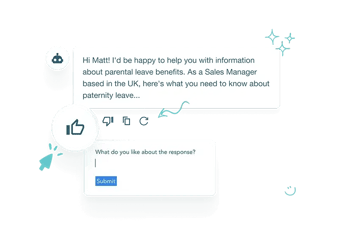
Context-aware, thoughtful, and insightful, AI Assistant brings clarity straight to the employee. A HR helper intuitively curates answers to routine questions using your existing knowledge sources, delivering only the information that counts.
And, when human HR is needed, it escalates with no forms needed.
HR Case Management
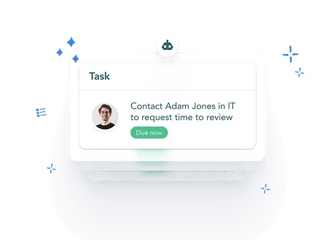 When complex and sensitive issues arise, or information simply doesn’t exist, employees need a system to fall back on. HR Case Management is that framework.
Either by raising a case directly, or self-service support tools like AI Assistant intuitively detecting an escalation is needed, case management connects employees with human support.
In doing so, it ensures there’s always a line of communication, even when knowledge systems can’t keep up.
Intelligent routing ensures the right agent receives the right case, with sentiment analysis, priority scoring, and transparent timelines to keep interactions smooth and fair.
Employee Journeys
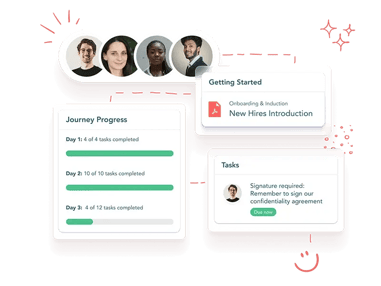 Employees naturally experience changes throughout their tenure with your organization, whether that’s their time as a new starter, their first performance review, or becoming a first-time manager.
Knowledge is intuitively and automatically delivered to employees at key touch points of these critical transitions, ensuring they have the support they need to reduce time to productivity and improve engagement.
Lives Anywhere
Knowledge is accessible from the tools employees already use, like Slack, Teams, and WhatsApp. This ensures cross-functional alignment and reduces employees’ requirement to context-switch.
When HRSD works for the employee, HR becomes the catalyst for collaboration where consistency and connectivity are paramount.
And it finally works for everyone: answers are in reach for employees, HR can remain focused on the bigger-picture, and teams can finally start to work in synergy.
Ready to see how Applaud can transform your HR experience? Let’s talk.

 About the Author
Scott Oakes is a Senior Technical Communications Specialist with a background in advertising, communication, creative writing, and video production. He plays a key role in shaping Applaud's YouTube channel, combining creativity and clarity to make technical how-to videos more engaging, ensuring that complex concepts are easy to understand.