








Why this matters now
Previously I argued that employee-first HR is not won by buying one more platform or centralising one more process. It is won by reducing friction, designing services around real employee moments, and removing the seams between knowledge, workflow and help.
This article goes deep on one capability only: how HR can use context and live signals to make support more relevant, more timely and more human, without becoming invasive or performative.
My view is blunt: the annual engagement survey is becoming the corporate equivalent of an autopsy. Useful, sometimes. Timely, rarely. It tells you what employees felt after the moment passed, after the manager fumbled the conversation, after the new hire got lost, after the returning parent quietly decided not to stay. That may have worked when change travelled at an annual planning cadence. It does not work when AI adoption, operating model change and workforce stress can move within a quarter. Stanford’s 2025 AI Index reports that 78% of organisations said they were using AI in 2024, up from 55% the year before, while Gallup-reported engagement figures for 2024 slipped to 21% globally and manager engagement to 27%. That is exactly the wrong combination for HR: faster change, weaker signals, more managerial fragility. (Stanford)
That is why hyper-personalisation and continuous listening now belong in the same sentence. They are not separate projects. Personalisation without listening is just guesswork with better branding. Listening without personalisation is a well-intentioned data lake that still treats everyone as an average. The real opportunity is contextual employee support: knowing enough about the moment, the role, the location, the manager, the channel and the likely need to remove effort and improve judgement, then learning continuously from what happens next. As newer enterprise AI becomes more agentic, that opportunity gets bigger. Anthropic’s Economic Index found that users were increasingly delegating more autonomous work to models, with directive task delegation rising from 27% to 39% over eight months, which is a useful signal that the practical frontier has shifted from answering to doing. HR now has to decide where that is genuinely helpful, and where it is unacceptable. (Anthropic)
Chapters
- Hyper-personalisation needs a new definition
- Continuous listening must replace survey theatre
- The next-gen operating practice
- How to build it without turning HR into a surveillance machine
- Privacy, ethics and the line HR must not cross
- The argument I would leave senior HR leaders with
 Report: Decoding the HR Service Delivery Ecosystem
HR teams are being asked to do more than ever. Everest's Tech Provider Spotlight explores how HR Service Delivery is evolving. Read Now.
Hyper-personalisation needs a new definition
Most HR personalisation has been underpowered.
It has meant showing country-specific policies, role-specific menus, or the right benefits article to the right person. That still matters. But it is not next-gen. The next version is not about more content variants. It is about relevance with memory, timing and action.
It is the difference between an employee opening a portal and searching for “parental leave”, and a system recognising a life event, surfacing the right task path, clarifying local policy, anticipating manager questions, and making it easy to escalate to a human when the issue becomes emotional, unusual or high-stakes. That is not a better FAQ. That is service design finally catching up with consumer expectations. (Stanford)
But here is the controversial part: a surprising amount of what passes for personalisation in HR is either cosmetic or creepy. Cosmetic personalisation changes the wording but not the experience. Creepy personalisation uses data simply because it exists. HR needs a harder standard.
Personalisation is only legitimate when it reduces employee effort, increases clarity, or improves outcomes in a way the employee would reasonably expect. If it does not do one of those things, it is not personalisation: it’s surveillance theatre wearing UX clothing. The UK ICO makes this point more crisply than most vendors ever will: “Just because a form of monitoring is available, does not mean it is the best way to achieve your aims.” (ICO)
That principle matters because HR is increasingly tempted to infer too much. Search behaviour, case history, attendance data, collaboration metadata, sentiment signals, health-related adjustments, learning patterns, manager feedback and productivity traces can all look irresistible when you are trying to “predict needs”. But the legal and ethical bar is not whether the data exists. It is whether the use is necessary, fair, proportionate, transparent and properly governed.
The ICO’s worker monitoring guidance explicitly warns that employers must balance business interests against workers’ rights, use the least intrusive means, avoid one-size-fits-all lawful bases, and recognise that consent is usually inappropriate in employment because of the imbalance of power. (ICO)
Personalisation Integrity
The sweet spot is what I call minimum viable context. Enough to help, not enough to spook:
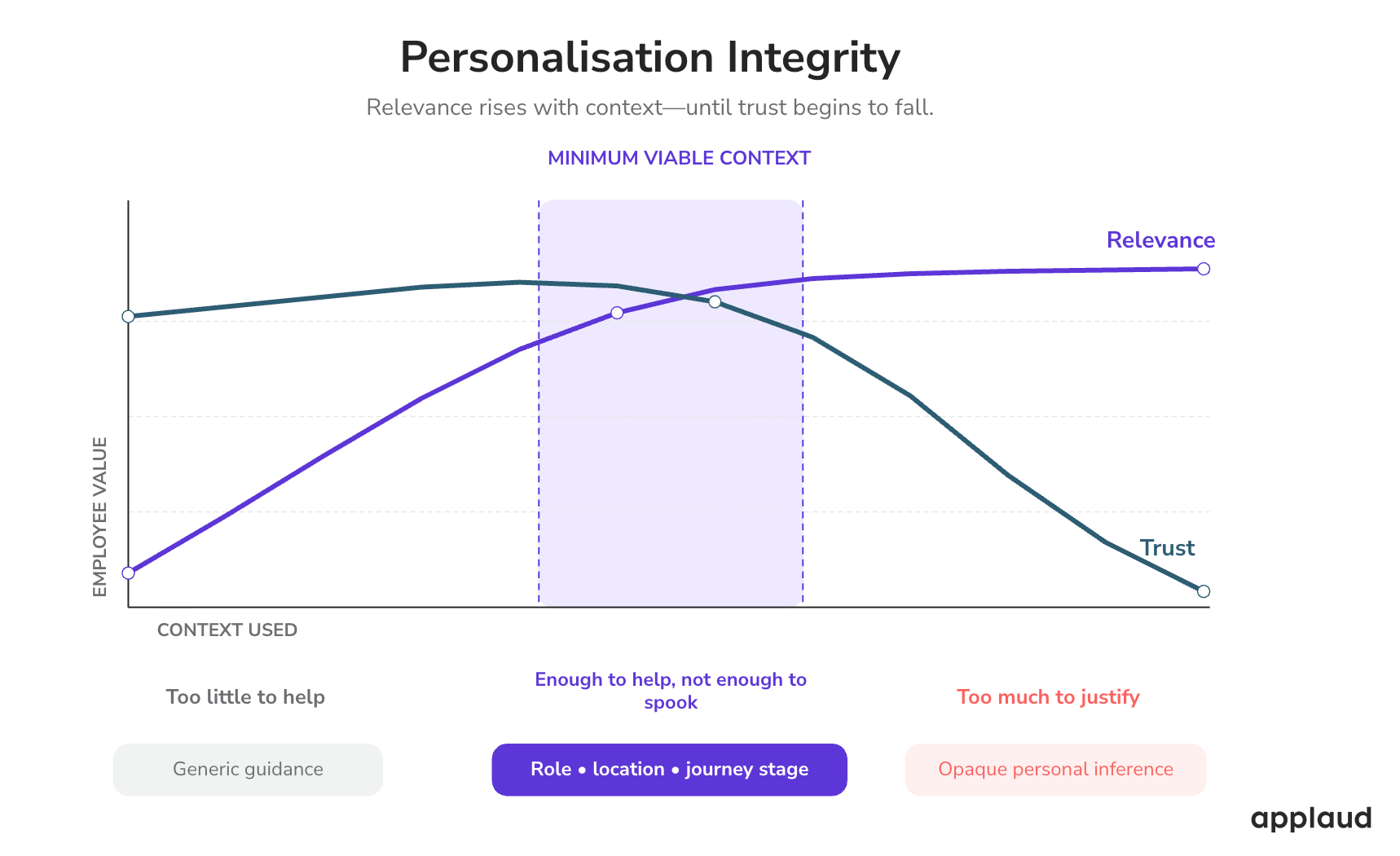
In practice, that usually means using a small number of job-relevant signals such as country, contract type, role, manager status, tenure band, current journey stage and prior support history. It usually does NOT mean scraping every collaboration trace, inferring mood from behaviour, or using health-like signals unless there is a very clear lawful basis, a clear employee benefit, and strong human safeguards. (ICO)
If you want a simple test for senior leaders, ask one question: Would I be comfortable explaining to an employee, in plain English, why this data was used right now?
If the answer is no, stop.
That single discipline would save many organisations from crossing the line between supportive HR and digital overreach. It would also align with the broader regulatory direction. The European Commission’s AI Act guidance makes clear that emotion recognition in workplaces is prohibited, while AI systems used for employment, worker management and access to self-employment are considered high-risk and subject to strict obligations around risk management, data quality, documentation, traceability, human oversight, robustness and accuracy. (EU AI Act)
Continuous listening must replace survey theatre
Continuous listening is often misunderstood as “more pulse surveys”. It is not. In fact, if your answer to every emerging issue is another pulse survey, you do not have a listening strategy. You have an email strategy.
Real continuous listening has four signal types.
- First Declared signals: what employees explicitly tell you through surveys, comments, case feedback, stay interviews and manager conversations.
- Second, behavioural signals: where they search, where they drop out, where they repeat steps, where they restart journeys, and where they ask for help after apparently self-serving.
- Third, operational signals: case spikes, reopen rates, policy exceptions, time-to-resolution, missed tasks, failed approvals and service bottlenecks.
- Fourth, contextual signals: role changes, relocation, parental status changes where appropriately known, return-from-leave events, manager changes, probation milestones, performance-cycle timing, and similar work-relevant moments. Together, these create a far richer picture than any one survey ever can. (Stanford)
This is also where earlier chapters on knowledge and architecture matter. If employees repeatedly search for the same thing and still open a case, that is a listening signal. If managers abandon a workflow halfway through, that is a listening signal.
If a life-event journey shows high drop-off at the same step across one geography, that is a listening signal. Listening is not a standalone programme; it is what becomes possible when your service layer, knowledge base, case data and journey data are connected well enough to show where effort, confusion and silence are building.
Listening Half-Life
Feedback has a half-life. The more immediate the issue, the faster the value of listening decays if nothing visibly happens.
.png?width=1794&height=1021&name=unnamed%20(29).png)
Operational pain points, such as broken processes, policy confusion or manager bottlenecks, have a very short half-life. If employees flag them and nothing changes within weeks, not months, trust drops sharply. Cultural and structural themes can tolerate slower action, but even then employees need to see acknowledgement, ownership and progress.
The practical implication is that the most important listening metric is no longer response rate. It is signal-to-visible-action time. If HR cannot shorten that, it will continue collecting feedback long after employees have stopped believing in it. That is one reason I would retire the applause given to “listening campaigns” that produce glossy decks and no operational movement. (WSJ)
Managers are essential here. Gallup-reported data show that manager engagement fell to 27% in 2024, and only 44% of managers globally have received formal management training. If managers are overloaded or poorly equipped, they become unreliable sensors and weak first responders.
Continuous listening therefore cannot be owned by the employee survey team alone. It has to sit inside everyday management habits: short check-ins, better questions, clearer escalation routes, and strong local action discipline. In other words, the manager is still the most important listening interface in the company. AI can help interpret patterns. It cannot replace relational judgement at the point of tension. (WSJ)
The next-gen operating practice
The real breakthrough in next-gen HR is not that AI can summarise comments or draft an action plan. It is that AI can now operate inside the service itself. The NBER field study on generative AI in customer support found average productivity gains of roughly 14% to 15%, with the strongest benefits accruing to less experienced workers.
That matters for HR because much of HR service quality has always depended on who you happen to get. Agentic and assistive AI can flatten that quality gap by making good practice more consistently available, especially in high-volume, repeatable, policy-grounded service. (ArXiv)
That does not mean the answer is to put a bot in front of everything. It means redesigning HR around three service speeds.
The Three Speeds of Listening and Response
.png?width=1823&height=1031&name=unnamed%20(30).png)
Immediate speed is where hyper-personalisation earns its keep. An employee asks a question, starts a journey, misses a step, encounters friction, or shows a credible sign of confusion. The system responds in the moment with the next right action.
Managerial speed is where local leaders review trends, spot team-level issues, and act before frustration hardens into attrition risk.
Structural speed is where HR decides whether the pattern points to a policy flaw, a design flaw, a resourcing issue or a management issue. The mistake many organisations make is reacting at the wrong speed. They overreact to noise at structural level, while underreacting to obvious problems at operational level. (ArXiv)
The interesting lesson is not “replace HR with AI”. It is that once routine informational work is handled at scale, HR gets room back to focus on the messy, human and judgment-heavy work where trust is actually built. That is the right ambition for hyper-personalisation: not fewer humans, but better-deployed humans. (FT)
There is an operating model implication here too. Moderna’s decision to merge technology and HR leadership responsibilities into a combined people-and-digital role is an early sign of where this is heading.
When support becomes contextual, continuous and AI-infused, people strategy and digital strategy stop being parallel topics. They become the same design problem: what work should be automated, what should be augmented, what should remain deeply human, and who governs the handoffs? That does not mean every company should copy Moderna’s structure. It does mean CHROs who still treat AI as an IT side conversation are already late. (WSJ)
How to build it without turning HR into a surveillance machine
The practical path is more disciplined than glamorous. Start with moments, not models. Pick the handful of employee moments where time, confidence and contextual relevance most affect outcomes: new hires, first-time managers, return from leave, payroll anomalies, internal moves, exits, and employees unexpectedly asking for the same help twice. If you cannot explain why a moment matters to the employee and the business, it is not a place to start.
Then build what I would call a listening map for each moment. What do employees explicitly say? What do they repeatedly do? Where do they get stuck? What does HR already know that is legitimate and useful? What would a manager plausibly see first? This is where you decide the minimum viable context. Most organisations do not fail because they lack data. They fail because they never agree which data is actually allowed to matter. (ICO)
Next, separate interventions into three categories:
- Universal interventions improve the experience for everyone: rewrite a confusing policy, remove a pointless approval, simplify a journey, clean up search, show status more clearly.
- Segmented interventions help a defined group: first-time supervisors, remote hires, hourly workers, mobile-first populations, or colleagues returning from family leave.
- Individual interventions should be rare, high-confidence and easy to explain. They are acceptable when the employee would reasonably expect them and they clearly help: surfacing country-relevant leave guidance, reminding a manager about an overdue onboarding step, or offering human assistance after a failed journey. They are not acceptable when they rely on opaque inferences about mood, intent or personal vulnerability. (EU AI Act)
After that, instrument the service properly. The metrics I would want every CHRO to see monthly are these:
- Signal-to-visible-action time: how long it takes from issue detection to a visible improvement.
- Action visibility rate: the percentage of employees who can identify a change made because feedback was heard. Relevance rate: how often personalised prompts are used or positively rated.
- False intimacy rate: how often a personalised intervention is judged irrelevant, invasive or based on a wrong assumption.
- Repeat-friction rate: how often the same employee has to ask for help twice on the same issue. Those are more useful than a generic participation score because they tell you whether listening is improving the lived experience, not merely generating artefacts. (ICO)
There is a clean business case here too. Use a simple value equation:
Annual value = employee time returned + HR capacity released + regrettable exits avoided – technology and change cost.
A modest illustration makes the point. Suppose 20,000 employees each save five minutes a month because support is more relevant, easier to complete and less likely to require repeat contact. That returns 20,000 hours a year. At £30 an hour, that is about £600,000 of employee time recovered. If improved self-service and AI assistance remove 15,000 routine contacts a year at 10 minutes each, and HR operating cost is £38 an hour, that is another £95,000 of capacity.
If better listening and targeted intervention prevent just 20 regrettable departures with a conservative replacement cost of £25,000 each, that is £500,000 more.
Suddenly this is not a “nice employee experience initiative”. It is a seven-figure operating and retention lever. The exact numbers will differ by organisation, but the value logic is real, and it is consistent with field evidence that AI assistance can raise productivity and reduce the steepness of experience gaps between stronger and weaker operators. (ArXiv)
A subtle technology point is worth adding. In practice, this works best when personalisation and listening sit in the employee-facing service layer, not buried inside the core HRIS. Employees do not experience your architecture diagram. They experience the front door, the search, the guidance, the task flow, the escalation and the follow-through.
A system such as Applaud is relevant here only as an example of that employee-facing service layer: knowledge, journeys, AI assistance, analytics and case flow working together around the employee rather than around the back-office team. That is not a product pitch. It is an architectural point about where modern HR service value is created.
Privacy, ethics and the line HR must not cross
HR loses trust because employees can feel when technology is being done TO them rather than FOR them.
The fastest way to destroy a promising listening strategy is to turn it into hidden performance scoring, silent behavioural inference or automated people decisions with no meaningful human recourse. The ICO could not be clearer. Employers must be transparent about monitoring, use the least intrusive means, and remain cautious where workers would not reasonably expect the monitoring. Article 22 UK GDPR limits solely automated decisions with legal or similarly significant effects, and the ICO states that when human oversight is used it must be meaningful, not tokenistic. People making supported decisions must remain engaged, critical and capable of going against the system’s recommendation. (ICO)
That is more than a legal technicality. It is a design rule. I would turn it into a hard editorial line for HR:
"never make a consequential employee decision from an inferred signal alone."
Use signals to prompt review, not to close judgement. If an AI model flags burnout risk, attrition risk or disengagement risk, the next step is a human conversation, not an automated label. If a dashboard says somebody is low-performing because of digital exhaust, the right reaction is scepticism first, action second. This is especially important because AI systems can create a false sense of objectivity. Experimental research has shown that workers may tolerate lower pay under AI management without the same demotivating response they show to human managers, suggesting that algorithmic authority can suppress the normal social reactions that would otherwise check unfairness. That should worry every HR leader. (ArXiv)
The Serco case is the cautionary tale. In 2024, the ICO ordered Serco Leisure to stop using facial recognition and fingerprint scanning to monitor staff attendance, finding that the biometric processing of more than 2,000 employees was unlawful and that less intrusive alternatives existed. HR leaders should read that case carefully, because it is the future arriving early. Just because a technology promises cleaner data or tighter control does not mean it passes the tests of necessity, proportionality, fairness or trust. If your personalisation strategy depends on invasive monitoring, you have a reputational risk with a dashboard, not a modern HR strategy. (The Guardian)
The EU direction reinforces this. The Commission’s AI Act summary states that emotion recognition in workplaces is a prohibited practice and that AI tools for employment, worker management and access to self-employment are high-risk systems subject to strict obligations. For organisations with EU operations, that means the era of sloppy experimentation in HR AI is over. You need traceability, data quality discipline, human oversight, and a serious governance model before you scale. The 2025 Stanford AI Index also notes a wider gap between recognition of responsible AI risks and meaningful action, which is another way of saying that many organisations still talk more responsibly than they operate. (EU AI Act)
.png?width=94&height=94&name=Copy%20of%20LinkedIn%20Ads%20TOFU%20Lead%20Gen%20-%20AI%20playbook%20-%20Square%20(5).png) Cultivating an Employee-First Mindset
Cultivating an Employee-First Mindset
Learn how to transform HR into a people-first function that builds trust, designs better experiences, and drives real business results in this interactive, 10-minute guide. Read Now.
The argument I would leave senior HR leaders with
Hyper-personalisation is not the future because employees want to feel “known” by a machine. It is the future because employees are tired of doing diagnostic work that HR should have done already. They are tired of translating their lives into generic categories, re-explaining context, hunting for the right form, waiting for routine answers, and being surveyed about pain that was visible in the service data all along. Continuous listening matters for the same reason. Not because HR needs more dashboards, but because employees need fewer avoidable frustrations. (ICO)
So the strategic shift is this: move HR from episodic measurement to contextual responsiveness. Stop treating personalisation as a content trick. Stop treating listening as a survey programme. Build an operating discipline that senses what employees are actually encountering, acts at the right speed, uses the minimum viable context, and keeps humans responsible for consequential judgement. If you do that, AI will help HR feel more human, not less. If you do not, HR will simply become faster at being impersonal. (ArXiv)
That, in my view, is the real dividing line for next-gen HR service delivery. Not who has the smartest bot. Not who can boast the most pilots. The leaders who win this chapter of HR will be the ones who can make support feel timely, relevant and trustworthy at scale. In a world where AI is accelerating, employee trust is not a soft by-product. It is the operating system. (Stanford)
How Applaud Helps You Make It Happen
At Applaud, we believe employees are a company’s most important customers. That’s why our technology is built entirely from the employee’s point of view—delivering more human, intuitive, and rewarding HR experiences that empower HR teams to do more for their people.
If you’re ready to turn employee-first HR from vision to reality, we’re here to help. Get in touch to see how Applaud can transform your HR Service Delivery and create a workplace where employees truly thrive.


About the Author 
Duncan Casemore is Co-Founder and CTO of Applaud, an award-winning HR platform built entirely around employees. Formerly at Oracle and a global HR consultant, Duncan is known for championing more human, intuitive HR tech. Regularly featured in top publications, he collaborates with thought leaders like Josh Bersin, speaks at major events, and continues to help organizations create truly people-first workplaces.