








The ground has shifted. Microsoft’s 2025 Work Trend Index found that 82% of leaders see this as a pivotal year to rethink strategy and operations, 81% expect agents to be moderately or extensively integrated into their AI strategy within 12 to 18 months, and 24% say AI is already deployed organisation-wide. In other words, this is no longer a future trend monologue – it’s an operating model problem happening in real time (Microsoft).
That changes the brief for senior HR leaders. The future of HR service delivery is not a better portal, a shinier chatbot, or faster ticket routing. It is a design challenge: how do you create a service model that is personal without becoming creepy, continuous without becoming noisy, automated without becoming careless, and efficient without becoming cold? That is why I believe the defining role of next-generation HR is experience architect.
Chapters
- HR is becoming an experience architecture discipline
- The next battleground is adaptive relevance
- Personalisation without permission becomes surveillance
- Cross-functional hubs are the new service engine
- What to build in the next twelve months
- What remains unresolved
- The leadership mandate
 Report: Decoding the HR Service Delivery Ecosystem
HR teams are being asked to do more than ever. Everest's Tech Provider Spotlight explores how HR Service Delivery is evolving. Read Now.
HR is becoming an experience architecture discipline
The phrase matters because it forces a harder truth. HR is no longer judged only on policy quality, service efficiency, or even employee satisfaction in isolation. It is judged on whether the organisation can reliably turn employee intent into outcomes across fragmented channels, distributed teams, changing regulations, and now, increasingly, digital workers. Microsoft argues that the traditional org chart is starting to give way to a more dynamic “Work Chart”, built around outcomes and human-agent teams rather than static functional boundaries. That is exactly the terrain HR service delivery is moving into.
So let’s be blunt. The old mental model of HR service delivery as a support desk is already too small. A support desk answers questions. An experience architecture function designs how employees find help, trust help, complete actions, and move on with confidence. That is a different level of ambition. It is a redesign of how service is produced, consumed, and governed
The point is this: many HR functions are still trying to use AI to preserve the old service model a little more cheaply. That is the wrong ambition. The right ambition is to redesign the service model altogether.
The next battleground is adaptive relevance
Traditional shared services were built for consistency. The future is being built for relevance.
Why? Because work itself has become more fragmented, pressured, and context-dependent. 53% of leaders say productivity must increase, but 80% of workers and leaders say they lack enough time or energy to do their work. During the working day, employees are interrupted every two minutes by meetings, emails, or pings, adding up to 275 interruptions a day. Meanwhile, Gallup’s 2025 workplace data showed global employee engagement falling to 21% in 2024, with manager engagement at 27%, both warning signs for any function that still assumes service can be designed around standard workflows alone (Gallup).
That is why hyper-personalisation, continuous listening, and cross-functional service hubs matter. They are the only sane response to a work environment where generic support arrives too late, annual feedback cycles are too slow, and employees increasingly expect systems to understand context before they have to explain it three times.
Hyper-personalisation is not recommending the right article. It is about reducing employee effort at the moment of need. Continuous listening is not adding more surveys. It is about creating a live signal environment that combines operational data, employee feedback, manager observations, journey friction points, and service outcomes. Cross-functional hubs are not committees. They are decision-making units that can redesign a journey end to end instead of tossing pieces of it between HR, IT, payroll, legal, and communications.
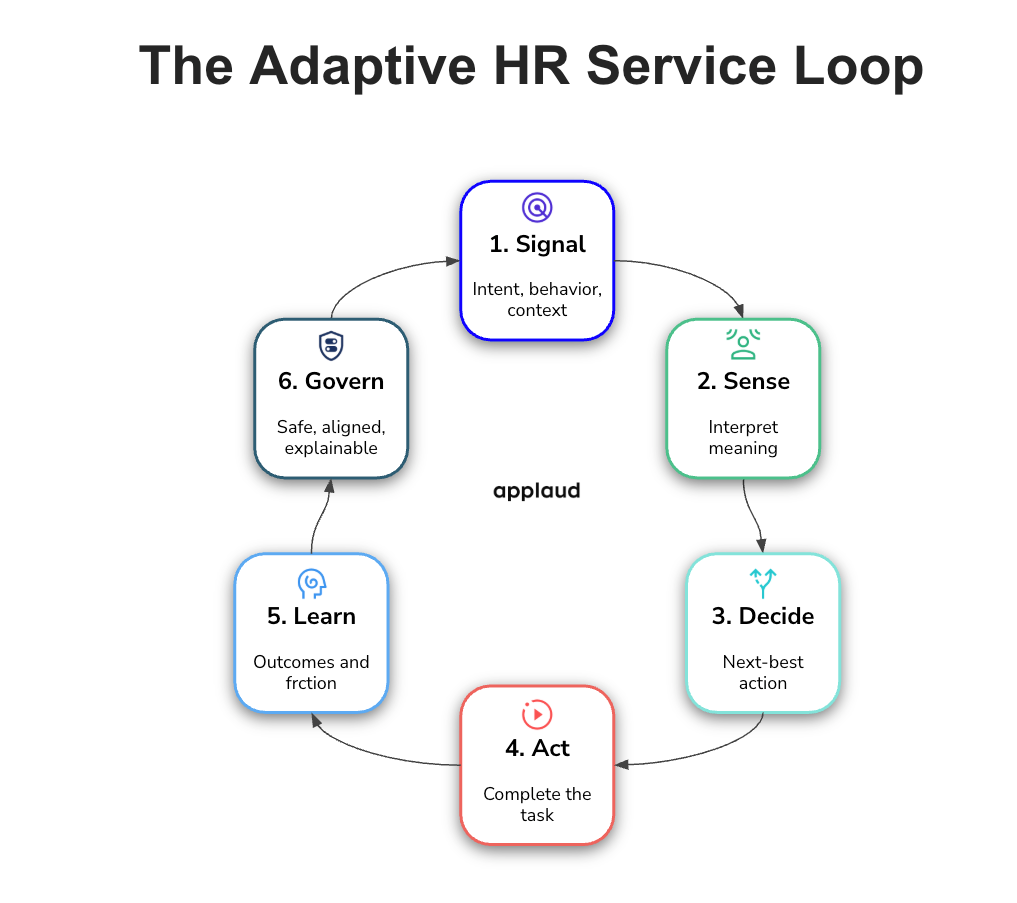
Signal means the employee’s intent, behaviour, and context. Sense means interpreting what that signal means for this person, in this role, location, and moment. Decide means choosing the next-best action, not merely the next available channel. Act means completing something meaningful, not just producing information. Learn means feeding outcomes, friction, and trust signals back into the service design. Govern means ensuring all of the above is traceable, explainable, safe, and policy-aligned. This is my synthesis, but it is grounded in the realities described by NIST’s emphasis on trustworthy AI risk management, and the growing need for connected AI-to-system architecture reflected in open standards such as Model Context Protocol (MCP).
That loop is where future HR service delivery wins or loses. Not at the portal. Not in the org chart. In the loop.
Personalisation without permission becomes surveillance
Not all personalisation is progress.
The European Commission’s explanation of the AI Act is a warning siren for HR leaders. It explicitly lists AI tools for employment, management of workers, and access to self-employment as high-risk use cases, subject to strict obligations including risk assessment, high-quality datasets, traceability, documentation, human oversight, robustness, and cybersecurity. It also prohibits certain practices outright, including emotion recognition in workplaces. NIST’s AI Risk Management Framework similarly emphasises trustworthiness, risk management, and governance as design requirements, not optional extras bolted on later (EU AI Act).
That matters because the temptation in HR is obvious. If more data can create more relevant services, then why not collect more signals from more systems, more often? Because the line between care and surveillance is thinner than many executives think.
The UK ICO has warned that employers must make workers aware of the nature, extent, and reasons for monitoring, and that excessive monitoring can undermine privacy, especially for people working from home. That should not be treated as a compliance footnote. It is a design principle (The Guardian).
Useful personalisation = relevance + timing + employee agency + explainability
Untrusted personalisation = opacity + overreach + irreversible inference
If the employee cannot see why the system knows something, cannot control what is used, cannot challenge a recommendation, or cannot opt out of certain forms of profiling, the experience will feel invasive no matter how accurate it is. And once trust breaks, adoption follows it down.
That is why the future of HR service delivery will favour permissioned personalisation, not stealth personalisation. The best systems will be context-aware, but they will also be visibly bounded. They will explain why a recommendation is being made. They will separate support from judgement. And they will reserve high-stakes decisions for accountable human oversight. That is not anti-AI. It is what serious AI operating models look like.
Cross-functional hubs are the new service engine
If experience is now the product, then HR cannot architect it alone.
Microsoft’s Work Trend Index argues that human-agent teams are starting to upend the org chart, and that dynamic, goal-based working models are emerging around outcomes rather than fixed functions.
At the same time, open standards are being built for connecting AI systems to business tools and data. Anthropic’s Model Context Protocol (MCP) was introduced precisely to replace fragmented one-off integrations with a common, open way to connect assistants to business systems and content repositories. The implication is bigger than the tooling. It means service delivery is becoming inherently cross-functional and increasingly machine-mediated.
That is why I expect the strongest organisations to move away from pure HR silos and towards experience hubs: small, accountable, cross-functional teams built around moments of need rather than functions of record.
Think about a parental leave journey. Or an international move. Or a pay problem. Or a manager trying to support a struggling team member. None of these are truly “HR only”. They cut across payroll, workflow, policy, identity, local regulation, communications, manager capability, and often wellbeing. Yet most organisations still route them through a fragmented maze and then wonder why employees lose trust.
An experience hub would treat that as one journey with one accountable design team.
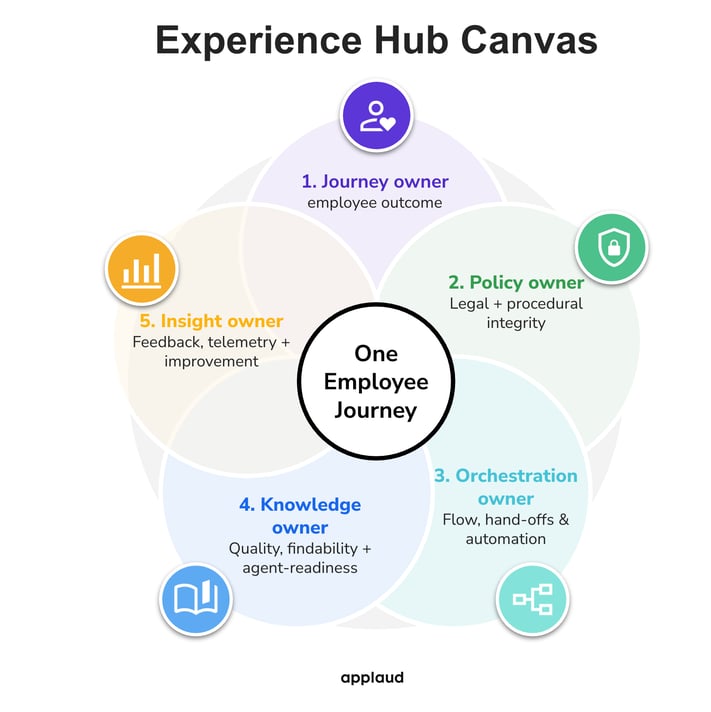
This is not another committee structure. It is a way of making cross-functional design operational.
And the business case is not theoretical. Dow expects to save millions in the first year through a supply-chain agent, a five-person startup boosting margins by 20% through AI, and an AI-first agency redistributing strategic expertise so that it no longer needs a strategist on every brief. These are not HR examples, but that is exactly why they matter. They show what happens when organisations stop using AI as a feature and start using it to redesign how expertise flows. HR service delivery is next in line.
What to build in the next twelve months
1. Pick one journey that is both emotionally important and operationally messy
Do not start with a generic chatbot rollout. Start with something employees actually remember: internal moves, manager support, leave, payroll exceptions, onboarding, UKG/Workday/SAP hand-offs, whatever causes the most re-explaining, chasing, and distrust in your environment.
2. Instrument the journey for effort, not just efficiency
Measure the things employees feel: how many hand-offs happened, how often they had to repeat themselves, whether the issue was actually completed, whether they trusted the answer, whether a manager had to step in, and how long it took to reach the first meaningful action. If you only measure ticket volume and SLA response times, you are measuring HR’s convenience, not employee reality (hint: get serious with XLAs).
3. Create a real experience hub around that journey
HR, IT, payroll, legal, internal comms, and where relevant, security or operations. Small team. Named owner. Shared metrics. Short cycles. The goal is not consensus theatre. The goal is working improvements shipped quickly.
4. Rebuild your knowledge layer for agentic use
Most HR knowledge bases were written for browsing, not for reasoning and action. That has to change. Articles need clean ownership, jurisdiction logic, decision points, exceptions, and escalation criteria. Anthropic’s rationale for MCP is instructive here: connected systems fail when knowledge remains trapped in silos and every integration has to be handcrafted. [8]
5. Set autonomy bands before you scale agents
Decide what AI can answer, what it can complete, what it can recommend, and what it must never decide. The AI Act’s treatment of employment-related AI as high risk should force discipline here. So should basic common sense. An agent can pre-fill, explain, route, summarise, translate, and surface policy. It should not quietly become the de facto decision-maker in high-stakes people matters (EU AI Act).
6. Invest in new HR capabilities, not just new tools
The World Economic Forum’s 2025 report found that 39% of workers’ existing skills are expected to be transformed or become outdated by 2030, that 59 out of every 100 workers will need training, and that 63% of employers see skills gaps as the biggest barrier to transformation. If you want future-ready HR service delivery, you need some combination of product thinking, service design, knowledge engineering, conversation design, workflow orchestration, analytics, and AI governance inside HR. Waiting for IT to do all of that for you is a strategic cop-out (World Economic Forum).
7. Train managers as part of the service model. One of the most under-discussed truths in HR service delivery is that managers are often the real tier-one support channel. Gallup’s manager engagement slump should worry every CHRO, because a burnt-out, under-equipped manager does not just harm team culture; they become a broken service channel. Future HR service delivery will depend on managers who can interpret guidance, use AI support wisely, and know when to escalate without creating confusion (The Wall Street Journal).
If you do those seven things well, you will already be ahead of most organisations that are still mistaking AI experimentation for service transformation.
.png?width=94&height=94&name=Copy%20of%20LinkedIn%20Ads%20TOFU%20Lead%20Gen%20-%20AI%20playbook%20-%20Square%20(5).png) Cultivating an Employee-First Mindset
Cultivating an Employee-First Mindset
Learn how to transform HR into a people-first function that builds trust, designs better experiences, and drives real business results in this interactive, 10-minute guide. Read Now.
What remains unresolved
I should admit what is still unsettled.
We do not yet have a universally mature answer to agent identity, inter-agent trust, auditability across multiple vendors, or the safe delegation of actions across heterogeneous systems. Emerging standards are moving quickly, and the existence of MCP and agent-interoperability protocols is encouraging, but the governance and security model for large-scale agentic work is still evolving. That is why NIST’s risk-management framing matters so much (Anthropic).
We also do not yet know how many organisations will have the courage to redesign work rather than merely automate fragments of it. Plenty of firms will deploy agents faster than they redesign roles, governance, or accountability. That is where the real implementation risk sits
And finally, the ethics of sensing employees more continuously will remain contested. The more powerful listening becomes, the more intentional consent, transparency, and limits must become. Future-ready HR must not only ask, “Can we do this?” but “What kind of relationship with employees does this design create?” The law is beginning to answer part of that question; leadership judgment must answer the rest.
The leadership mandate
The future of HR service delivery will not belong to the organisations with the most AI demos. It will belong to the ones that make work feel clearer, fairer, faster, and more human at the exact moment complexity is rising.
That is why I think “experience architect” is more than a nice phrase. It is the next operating identity for HR. The architect does not answer every question personally. The architect designs the conditions under which good answers, good actions, and good judgement happen consistently across people, systems, channels, and now agents.
So yes, hyper-personalisation matters. Continuous listening matters. Cross-functional hubs matter. But the deeper shift is this: HR must move from being the owner of a support function to being the designer of an adaptive service system.
And that work cannot wait for some distant future chapter. The disruption is already here. Regulators are already drawing red lines around workplace AI. Employers already know skills gaps are the biggest barrier to transformation. The only real question is whether HR will lead this redesign or inherit it from someone else.
My view is simple. HR should lead. Not because it owns every system, but because it is the function best placed to insist that the future of service is not just more automated, but more intentional. Not just more predictive, but more trustworthy. Not just more efficient, but more worthy of the people who have to live inside it every day.
How Applaud Helps You Make It Happen
At Applaud, we believe employees are a company’s most important customers. That’s why our technology is built entirely from the employee’s point of view—delivering more human, intuitive, and rewarding HR experiences that empower HR teams to do more for their people.
If you’re ready to turn employee-first HR from vision to reality, we’re here to help. Get in touch to see how Applaud can transform your HR Service Delivery and create a workplace where employees truly thrive.


About the Author 
Duncan Casemore is Co-Founder and CTO of Applaud, an award-winning HR platform built entirely around employees. Formerly at Oracle and a global HR consultant, Duncan is known for championing more human, intuitive HR tech. Regularly featured in top publications, he collaborates with thought leaders like Josh Bersin, speaks at major events, and continues to help organizations create truly people-first workplaces.